
Is Injera Halal?
Yes — this one is Halal.
Injera is the spongy, sour flatbread of Ethiopia and Eritrea, made from teff flour and water fermented for a few days and cooked on a griddle.
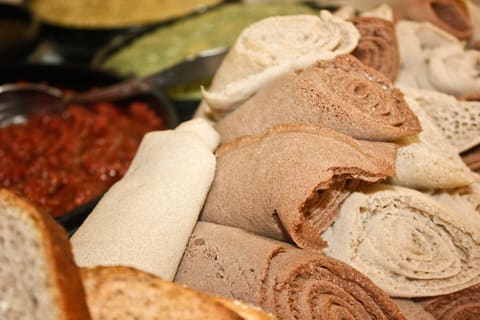
Photo: Lelaw Wondimu · CC BY-SA 4.0
What decides the answer
-
Injera on its own
Halal -
With lentil, chickpea or vegetable stews (the fasting platter)
Halal -
With chicken, beef or lamb from Halal slaughter
Halal -
With meat of unknown slaughter
Halal if verified
Why this ruling
Injera is the soft, spongy, slightly sour flatbread of Ethiopia and Eritrea. It is made from teff, a tiny native grain, mixed with water and a starter and left to ferment for two or three days, then poured onto a wide griddle and cooked on one side until the surface is full of holes. It is both plate and cutlery: stews are spooned onto a large round, and you tear off pieces to scoop them up.[2][1]
The bread itself
Injera is teff flour, sometimes blended with wheat or barley, water and the fermented starter. It is a plant food, and it is Halal. The fermentation makes it sour in the way sourdough is sour; it is bread, not an intoxicant.
What is served on it
| Dish | What it is | Halal? |
|---|---|---|
| Misir wot, shiro, kik alicha | Red lentils, chickpea flour, split peas | Yes |
| Gomen, atakilt | Greens, cabbage, carrot and potato | Yes |
| Doro wot | Chicken stewed in berbere with egg | Only from Halal slaughter |
| Siga wot, tibs | Beef or lamb, stewed or sautéed | Only from Halal slaughter |
| Kitfo | Raw minced beef with spiced butter | Only from Halal slaughter |
Many dishes are cooked with niter kibbeh, a spiced clarified butter, which is dairy and fine.
Fasting platters
Ethiopian Orthodox Christians fast on many days of the year, avoiding all animal products, so Ethiopian restaurants almost always offer a vegetarian fasting platter (yetsom beyaynetu) of lentils, chickpeas and vegetables on injera. It is the easy Halal order anywhere.
Meat and drinks
Ethiopia has a large Muslim population, and Muslim butchers and restaurants serve Halal meat; Christian-run restaurants slaughter differently. Abroad, ask whether the meat is Halal.[3] Many Ethiopian restaurants also serve tej, a honey wine, and local beers; tej is alcoholic and not Halal, even though it is made from honey (see honey for honey itself).
For the rest of the region, see the East Africa guide.
How to verify
- Injera is teff flour (sometimes with wheat or barley), water and a starter, fermented and cooked.
- Lentil, chickpea and vegetable stews are Halal.
- Chicken, beef and lamb stews need Halal slaughter; kitfo is raw beef.
Quick checks
- Injera itself is teff flour and water: Halal.
- Meat stews such as doro wot, key wot and tibs need Halal meat; ask the restaurant.
- Vegetarian dishes such as shiro and misir are the simplest; skip tej, the honey wine.
Frequently asked questions
Is injera Halal?
Is the fermentation in injera a problem?
What is served on injera?
Is tej Halal?
Scholarly view
Teff, water and the fermentation starter are Halal; injera is sour like sourdough and is not an intoxicant. Meat stews follow the slaughter of the meat.
Sources
Named Islamic, certifier, manufacturer, and regulatory sources used on this page. Inline markers like [1] jump here. Retrieval dates show when we last checked the live URL. Editorial methodology.
Islamic / scriptural
Context / background
-
Wikipedia Retrieved
Culinary identity: Sour fermented flatbread with a spongy texture, traditionally made of teff flour; a staple in Ethiopia. Identity context, not a Halal certificate.
-