
Is Ghee Halal?
Yes — this one is Halal.
Ghee is clarified butterfat from milk of Halal animals (typically cow or buffalo).
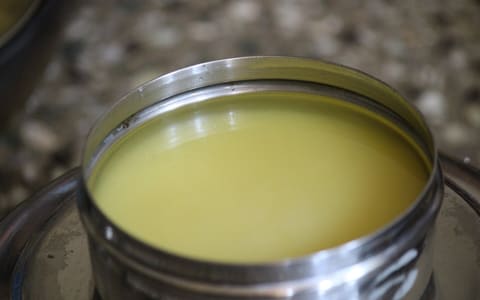
Photo: Phadke09 · CC BY-SA 4.0
What decides the answer
-
Plain dairy ghee from Halal-animal milk
Halal -
Vanaspati / vegetable 'ghee': judge as a separate fat product
-
Flavoured or meat-stock ghee: verify additives
-
Restaurant 'ghee': confirm dairy vs shortening
Where you'll find it
- High-heat frying and sautéing
- South Asian sweets and halwa
- Finishing dals, rice, and breads
- Ayurvedic and traditional preparations
Why this ruling
Ghee is clarified butter: butter simmered so water evaporates and milk solids brown and are strained away, leaving almost pure butterfat with a nutty aroma and high smoke point. It is central to many South Asian kitchens and increasingly sold worldwide as a cooking fat. Because it is dairy from Halal animals, the baseline ruling is Halal—the same family as butter and milk.
On the shelf
Pure ghee is one ingredient. Gold Medal's pure butter ghee lists "Milk fat (min. 99.8%), flavour",[4] and Target's Good & Gather ghee lists only "clarified butter".[5] Milk from livestock is described in the Qur'an as "pure milk, palatable to drinkers",[6] and it needs no slaughter, so dairy ghee is Halal. "Vegetable ghee" is a different product made from plant oils; see below.
Why dairy ghee is Halal
Milk from cows, buffalo, goats, and sheep is permissible. Clarifying that milk fat into ghee does not introduce a slaughter requirement. There is no pork step in traditional ghee-making. Qur'anic dietary baselines on forbidden categories are summarized for study at quran.com/5 (retrieved 20 July 2026); milk fat is not among the prohibited meats.
Dairy ghee vs vanaspati / 'vegetable ghee'
Label confusion is the main modern trap:
| Product | Typical base | Halal note |
|---|---|---|
| Desi / dairy ghee | Butter / cream from milk | Halal when plain |
| Vanaspati / vegetable ghee | Plant oils (often hydrogenated) | Usually Halal plant fat, but check emulsifiers; not true ghee |
| Blended cooking fats | Mixed dairy + plant | Read each product |
U.S. dairy identity and labelling context sits under FDA food labeling rules (fda.gov, retrieved 20 July 2026)—useful for understanding what packages claim, not as a Halal certificate. In Muslim markets, certified dairy brands may appear in JAKIM's portal (MYeHALAL, retrieved 20 July 2026).
Flavoured and industrial products
Watch for:
- Garlic, spice, or 'tadka' ghee with unclear flavour carriers
- Meat-stock infused cooking fats marketed beside ghee
- Emulsifiers in cheap blends
- Shared scoops in buffet kitchens that also serve pork dishes
Homemade ghee from Halal butter is straightforward. Imported novelty jars deserve an ingredients pass.
Restaurant reality
Many restaurants say 'cooked in ghee' when they mean any rich fat. Ask whether it is dairy ghee or vegetable shortening. For sweets and breads finished with ghee, the same question applies. Cross-contact with non-Halal meat juices is a kitchen-process issue, not a flaw in ghee as an ingredient.
Realistic verification
- Buy jars that list milk fat / butter only (plus salt if any).
- Treat vanaspati as a separate margarine-like product.
- Re-check flavoured products.
- Prefer Halal-marked dairy when you want audited supply chains.
- At restaurants, ask the fat question explicitly.
Homemade ghee and temple/ritual marketing
Making ghee at home from salted or unsalted butter is straightforward: simmer gently, skim, and strain. Start from butter you already accept as Halal dairy. You do not need a slaughter certificate for the jar you clarify on your stove. Commercial jars sometimes market 'grass-fed,' 'Ayurvedic,' or ritual purity language. Those claims may matter for nutrition or culture; they are not Islamic Halal audits. Conversely, a plain supermarket ghee with a short dairy-only list is usually fine even without spiritual branding.
In South Asian sweet shops, laddoos and halwa are frequently finished with ghee. The fat is rarely the failure mode—gelatin in decorations, non-Halal gelatinous fillings, or alcohol in some modern fusion desserts are more common. Ask about the ghee source when the shop also fries meat samosas in shared oil if cross-contact worries you; for vegetarian mithai cooked only in dairy ghee, the baseline remains comfortable for most Muslims.
How to verify
- Prefer single-ingredient dairy ghee (milk fat only) from cow, buffalo, goat, or sheep milk.
- Distinguish true ghee from vanaspati/'vegetable ghee'—read the fat source.
- Skip meat-flavoured or stock-infused ghee products unless certified.
- In restaurants, ask whether 'ghee' is dairy clarified butter or a cheaper vegetable shortening.
- Cultured or spiced ghee: check for wine, animal enzymes, or non-Halal seasonings.
Frequently asked questions
Does ghee need Islamic slaughter?
Is vegetable ghee the same as desi ghee?
Is ghee different from butter for Halal?
Can lactose-intolerant Muslims use ghee?
What should I ask at a restaurant?
Scholarly view
Classical fiqh treats milk and butterfat from Halal livestock as permissible without a slaughter step. Ghee is simply butter with water and milk solids removed. Contemporary confusion comes from marketing: 'vegetable ghee' or vanaspati is often hydrogenated plant oil, and some industrial blends use emulsifiers that deserve a label read. Pure dairy ghee remains the baseline Halal cooking fat in this category.
Sources
Named Islamic, certifier, manufacturer, and regulatory sources used on this page. Inline markers like [1] jump here. Retrieval dates show when we last checked the live URL. Editorial methodology.
Islamic / scriptural
-
Retrieved
-
Qur'an Retrieved
'And indeed, for you in grazing livestock is a lesson. We give you drink from what is in their bellies, between excretion and blood, pure milk, palatable to drinkers.'
Certifier / jurisdiction
-
Retrieved
Manufacturer / product
-
Gold Medal Pure Butter Ghee (8710314000796)
Open Food Facts (pack record) Retrieved
Record updated July 2026. Ingredients: 'Milk fat (min. 99.8%), flavour'.
-
Good & Gather Ghee Clarified Butter (0085239084656)
Open Food Facts (pack record) Retrieved
Ingredients: 'clarified butter'.
Regulatory / labelling
-
Retrieved
Halal-conscious recipes
A substitution-led recipe that uses this analysis.
Browse this topic
Open the parent category hub for more foods in the same group.