

Halal-conscious recipe
Chapli kebab
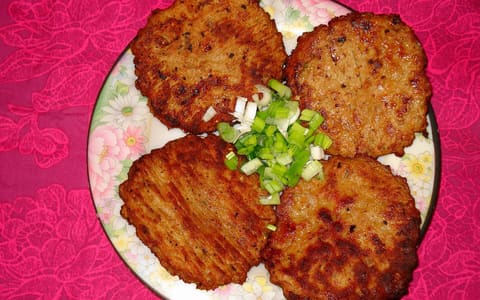
Flat Peshawari beef kebabs with tomato, pomegranate seed and crushed coriander, fried in oil or Halal beef fat, never lard or unknown dripping.
Each method follows published technique for the dish, and every Halal substitution is checked against the ingredient pages we cite. Photographs come from our ingredient library rather than the finished dish.
Why Halal checks matter here
Chapli kebabs are traditionally fried in beef fat; outside Pakistan, supermarket dripping is rarely from Halal slaughter, and the mince needs a Halal source too.
Chapli kebabs come from Peshawar, where they are fried in huge flat pans of beef fat along the kebab streets of the old city. The name is usually traced to the Pashto word for flat, and that is the point: unlike a seekh kebab, a chapli kebab is a wide, thin round of coarse beef mince, studded with tomato, onion, crushed coriander and dried pomegranate seed, and fried until the edges turn crisp and lacy.
Two things decide whether a chapli kebab is Halal: the mince and the fat. The mince should come from a Halal butcher, ideally a fatty cut like brisket minced for you. The traditional frying fat is beef fat, which is fine when the beef is Halal. Outside Pakistan, supermarket beef dripping is rarely from Halal slaughter, and some takeaways fry in lard or catering shortening, so render your own fat from Halal trimmings or use oil. Ghee works too.
Keep the mix loose and the kebabs thin. Chapli kebabs are meant to be rough-textured and a little crumbly, so knead only until the mix holds.
Eat them hot on naan with raw onion, lemon and a sharp green chutney.
Halal-critical ingredients
- Frying fat The traditional frying fat is beef fat. Outside Pakistan, beef dripping from a supermarket is rarely from Halal slaughter, and some takeaways use lard or catering shortening of unstated origin. Render fat from a Halal butcher's beef, or use plain vegetable oil. Never lard. See Lard.
- Beef mince Supermarket mince is rarely Halal-slaughtered, and mince can be processed on equipment shared with pork. Ask a Halal butcher to mince a fatty cut such as brisket or chuck for you. See Beef.
- Frozen chapli kebabs Ready-made kebabs can use mixed meat or binders and flavourings of unstated origin. Buy only certified packs, or make them at home; they freeze well raw between sheets of paper.
Safe substitutes
- Supermarket beef dripping or lard → Beef fat rendered from Halal trimmings, butter ghee, or vegetable oil
- Uncertified mince → Halal beef brisket or chuck, minced by a Halal butcher
- Dried pomegranate seeds → A teaspoon of pomegranate molasses, or ½ tsp amchur
Allergens
egg
Ingredients
Kebab mix
- 500 g (1.1 lb) Halal beef mince, coarse, 20–25% fat
- 100 g (1 medium) onion, finely chopped and squeezed dry
- 100 g (1 medium) tomato, seeded and finely chopped
- 2 green chillies, finely chopped
- 10 g (¾ in piece) ginger, grated
- 10 g (¼ cup) fresh coriander, chopped
- 1 egg
- 20 g (2 tbsp) maize flour (makki atta) or fine cornmeal
- 5 g (1 tbsp) coriander seeds, toasted and coarsely crushed
- 3 g (1 tsp) cumin seeds, toasted
- 6 g (1 tbsp) dried pomegranate seeds (anardana), crushed
- 3 g (1 tsp) crushed red chilli flakes
- 1 g (½ tsp) black pepper, coarsely ground
- 7 g (1 tsp) fine salt
To fry and serve
- 120 ml (½ cup) Halal beef fat, rendered, or neutral oil
- 1 tomato, sliced into thin rounds
- 4 naan
- 1 (1 portion) sliced onion, lemon and green chutney
Method
- Mix and rest. Put the mince in a bowl with everything from the kebab mix. Knead with your hand for 3–4 minutes until the mix is sticky and holds together. Chapli kebabs should be coarse and loose compared with seekh kebabs, so do not overwork it. Chill for 30 minutes.
- Shape thin. Wet your hands and divide the mix into 8 balls. Press each into a thin round about 12 cm across and 8 mm thick, on a sheet of baking paper. Press a thin tomato slice into the top of each. Thin and wide is what gives chapli kebabs their crisp, lacy edge.
- Check the fat. Peshawar kebab houses fry in rendered beef fat. At home, use beef fat you rendered from a Halal butcher's trimmings, or neutral oil. Supermarket beef dripping is rarely from Halal slaughter, and lard is pork fat. See Lard and Ghee.
- Shallow-fry. Heat the fat in a wide, heavy pan to about 180 °C. Slide in two or three kebabs, tomato side down first, and fry 3–4 minutes a side until deep brown, crisp at the edges and cooked through (71 °C in the centre). Drain on a rack.
- Serve. Serve hot on naan with sliced onion, lemon and a green chutney of coriander, mint and green chilli.
How this recipe was researched
Method specified editorially from Peshawar chapli kebab technique (coarse fatty beef mince mixed with tomato, onion, dried pomegranate seed, crushed coriander, maize flour and egg, pressed into thin rounds and shallow-fried in plenty of fat) and this site's Beef, Lard and Ghee pages. Timings follow published technique rather than a kitchen test.
Technique and ingredient sources
-
Chapli kebab — Wikipedia
Retrieved:
A flat, round Pashtun kebab from Peshawar made with minced beef, spices and dried pomegranate seeds, traditionally fried in fat.
-
Beef analysis — isithalal.food
Retrieved:
Slaughter, certification and what to ask a butcher.
-
Lard analysis — isithalal.food
Retrieved:
Why lard is pork fat and how it hides in takeaway frying.