
Is Sunflower Oil Halal?
Yes — this one is Halal.
Sunflower oil is pressed and refined from sunflower seeds.
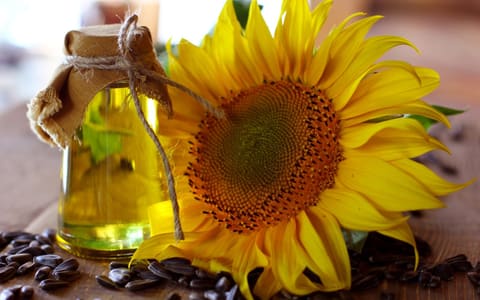
Photo: torange.biz · CC BY 4.0
What decides the answer
-
Sunflower oil named on the label
Halal -
High-oleic sunflower oil
Halal, a cultivar difference not a source one -
Sunflower oil with a declared antioxidant (E304, E306)
judge that additive -
Blend listing sunflower among other named oils
Halal, read the full origin list -
Fried product using sunflower oil
judge the food and the fryer, not the oil
Where you'll find it
- Frying and roasting oil
- Crisps and snack frying
- Mayonnaise and dressings
- Margarines and spreads
- Tinned fish and antipasti
Why this ruling
Sunflower oil is pressed from the seed of the sunflower and refined into the pale, neutral cooking oil that fills supermarket shelves and industrial fryers. As Halal questions go, it is one of the shortest: a plant is not an animal, and pressing a seed is not fermentation.
The name is doing the work
The reason sunflower oil is easier than a vague fat declaration is that the label has already named the plant. That is not a courtesy — under EU rules, refined vegetable oils may only be grouped under "vegetable oils" when that grouping is “followed immediately by a list of indications of specific vegetable origin” (Regulation (EU) No 1169/2011, Annex VII Part A, retrieved 25 August 2026).[1]
So a pack reading "sunflower oil" has answered the origin question outright. There is no hidden fat to identify, which is the entire reason vague fat wording is treated with caution in the first place.
The governing principle then applies without friction: things are permissible unless evidence shows otherwise (IslamQA 231261, retrieved 25 August 2026).[2] Nothing about a seed oil supplies that evidence.
Refining does not change the source
Crude sunflower oil is degummed, neutralised, bleached, and deodorised before it reaches a bottle. Those steps strip free fatty acids, pigment, and smell using physical treatment and food-grade aids. What comes out is the same plant oil that went in — the process changes clarity and shelf life, not origin.
High-oleic sunflower oil is likewise not a different substance. It is a cultivar bred for more oleic acid and better heat stability, chosen by fryers for that reason. Same plant, same ruling.
The one line worth reading next to it
Oils oxidise, so manufacturers often declare an antioxidant alongside them. That additive, not the oil, is the thing to look at:
- Tocopherols (E306) — usually extracted from vegetable oils; see the E306 page.
- Synthetic alpha-tocopherol (E307) and related codes — laboratory-made.
If a pack names one of these, judge it on its own entry. If it names none, there is nothing further to check.
Where the real question actually lives
For a fried product, the oil is rarely the issue — the fryer is. A sunflower-fried snack sharing a line with a pork-containing product raises a cross-contact question that has nothing to do with the oil's origin. Similarly, a margarine built on sunflower oil still needs its emulsifiers and any dairy read.
Sunflower oil answers its own question. Spend the attention on what it was used to cook.
How to verify
- Treat sunflower oil as Halal — it is a named plant oil.
- Check whether an antioxidant such as E304 or E306 is declared next to it and judge that separately.
- On an oil blend, read the origin list the label is required to carry.
- Halal certification matters for the finished product, not for the oil as a commodity.
Quick checks
- A named plant oil settles the origin question.
- Read any antioxidant declared beside it.
- Fried foods are judged on the food and the fryer.
Frequently asked questions
Is sunflower oil Halal?
Does refining change the answer?
What is high-oleic sunflower oil?
Why do some labels say sunflower oil and others just say vegetable oil?
Should I look for Halal-certified sunflower oil?
Scholarly view
A seed oil raises none of the categories that make a food Haram. Sunflower oil is expressed from the seed of Helianthus annuus and then refined by physical and chemical steps that introduce no animal material; there is no slaughter question because there is no animal, and no intoxicant question because nothing is fermented.
Where a scholar or certifier does look closely at edible oils, the concern is a blend that hides an animal fat under a vague name, or a production line shared with lard — neither of which applies to an oil the label has named. A pack that says sunflower oil has already answered the question that vague fat declarations leave open.
Sources
Named Islamic, certifier, manufacturer, and regulatory sources used on this page. Inline markers like [1] jump here. Retrieval dates show when we last checked the live URL. Editorial methodology.
Islamic / scriptural
-
IslamQA 231261 — Everything Is Permissible in Islam Until Proven Prohibited
IslamQA Retrieved
Cites Ibn Taymiyah that in principle all things are permissible and pure, and al-Uthaymeen that the basic principle for foods and drinks is permissibility absent evidence to the contrary.
Regulatory / labelling
-
Regulation (EU) No 1169/2011 — Annex VII, Part A
European Parliament and Council Retrieved
Point 8 permits refined vegetable oils to be grouped as "vegetable oils" only when followed immediately by a list indicating the specific vegetable origin, optionally with "in varying proportions". Labelling law, not a Halal ruling.
People also check
Related ingredients and products for this item.