

Halal-conscious recipe
Moussaka without wine
Greek lamb moussaka with fried aubergine, potato and a cheese béchamel, made with Halal lamb mince, water in place of the red wine, and a rennet-checked hard cheese.
Each method follows published technique for the dish, and every Halal substitution is checked against the ingredient pages we cite. Photographs come from our ingredient library rather than the finished dish.
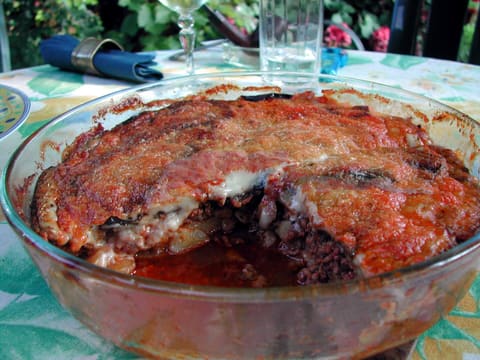
Photo: Fotograf: Dieter Mueller (dino1948) Kamera: de:Nikon 885 · CC BY-SA 3.0

Why Halal checks matter here
Many moussaka recipes reduce red wine into the meat sauce, the mince is only Halal if the lamb was slaughtered the Halal way, and the Parmesan in the béchamel is traditionally made with animal rennet.
Moussaka is fried aubergine and a spiced lamb sauce, layered in a dish and sealed under a thick béchamel. Many recipes, including BBC Good Food's, pour red wine into the meat sauce and reduce it by half before the tomatoes go in. This site does not treat cooked-down wine as Halal, and the dish does not need it: the tomatoes, cinnamon and a little sugar carry the sauce.
This version keeps the method and swaps three things. Water goes in where the wine was. The mince is Halal lamb (see lamb); beef works too. And the béchamel uses a hard cheese that names microbial, vegetable or Halal-certified rennet, because Parmesan is traditionally made with animal rennet.
Let the meat sauce cook down until it is thick, or the layers slide when you cut them, and rest the moussaka for 10 minutes after baking. The moussaka page covers what to ask in a Greek restaurant.
Halal-critical ingredients
- Red wine Many recipes, BBC Good Food's included, reduce red wine into the meat sauce. Cooking it down does not make it Halal on this site. Use water, as here. See Wine and Moussaka.
- Lamb mince Lamb is Halal only from Halal slaughter, and some shop or restaurant mince is mixed with pork. Buy from a Halal butcher or a certified pack. See Lamb.
- Parmesan Parmesan is traditionally made with animal rennet, and scholars differ on rennet from animals not slaughtered the Halal way. Use a hard cheese that names microbial, vegetable or Halal-certified rennet, or a cheese your practice accepts. See Parmesan.
Safe substitutes
- Red wine → The same amount of water
- Lamb mince of unknown source → Halal lamb or beef mince
- Parmesan → A hard cheese with microbial, vegetable or Halal-certified rennet
Allergens
milk (butter, milk, cheese), gluten (flour), egg
Ingredients
Aubergines
- 60 ml (4 tbsp) olive oil
- 900 g (3 medium) aubergines, trimmed and cut into 5 mm rounds
Meat sauce
- 30 ml (2 tbsp) olive oil
- 800 g (1¾ lb) Halal lamb mince
- 150 g (1 large) onion, finely chopped
- 10 g (2 fat cloves) garlic cloves, crushed
- 3 g (3 heaped tsp) dried oregano
- 5 g (2 tsp) ground cinnamon
- 0.4 g (2 leaves) bay leaves
- 200 ml (¾ cup + 1 tbsp) water, in place of the red wine
- 400 g (1 can) canned chopped tomatoes
- 32 g (2 tbsp) tomato purée
- 7 g (½ tbsp) light brown soft sugar
- 200 ml (¾ cup + 1 tbsp) water
Potatoes and béchamel
- 550 g (1¼ lb) floury potatoes, such as Maris Piper, peeled and cut into 5 mm rounds
- 40 g (3 tbsp) unsalted butter
- 40 g (⅓ cup) plain flour
- 450 ml (1¾ cups + 2 tbsp) whole milk
- 40 g (½ cup) hard cheese with microbial, vegetable or Halal-certified rennet, finely grated
- 0.5 g (a few gratings) nutmeg, freshly grated
- 50 g (1) large egg
- 17 g (1) egg yolk
Nutrition per serving
Estimated for 1 of 8 slices.
| Calories | 610 kcal |
|---|---|
| Fat | 43 g |
| of which saturates | 16 g |
| Carbohydrate | 32 g |
| of which sugars | 11 g |
| Fibre | 7 g |
| Protein | 25 g |
| Sodium | 250 mg |
Calculated from the metric quantities in the ingredient list, divided by 8, using USDA FoodData Central values for each raw ingredient. Cooking losses aren't modelled and brands differ, so these are estimates, not a lab analysis.
Where the list offers a choice, the first option is counted.
The rennet-checked hard cheese is counted as USDA grated Parmesan.
How each ingredient was counted
Method
- Fry the aubergines. Heat a frying pan over a high heat. Toss the aubergine rounds with the 4 tbsp of oil and fry in batches for 5 to 7 minutes until golden and starting to soften, adding a little more oil if the pan looks dry. Drain on kitchen paper.
- Make the meat sauce. Heat 1 tbsp of the oil in a large casserole over a medium-high heat and fry the lamb mince for 8 to 10 minutes until well browned, breaking it up, then tip it into a bowl. Add the remaining oil and the onion with a pinch of salt and cook gently for 10 to 12 minutes until soft. Stir in the garlic, oregano, cinnamon and bay for 1 minute.
- Simmer without wine. Return the lamb and pour in the first 200 ml of water where the original recipe uses red wine; let it bubble for a minute. Add the tomatoes, tomato purée, sugar and the second 200 ml of water, season, and simmer uncovered for about 20 minutes, stirring now and then, until thick.
- Par-boil the potatoes. Heat the oven to 200°C (180°C fan). Boil the potato slices in salted water for 6 minutes, drain and leave to steam dry for 10 minutes.
- Make the béchamel. Melt the butter, stir in the flour and cook for 1 minute. Off the heat, whisk in the milk a little at a time until smooth, then simmer for 3 minutes. Take it off the heat and whisk in the cheese, a little nutmeg, seasoning, then the egg and the yolk.
- Layer and bake. In a large ovenproof dish, spread a third of the meat, then half the aubergine and half the potato, then the rest of the meat, the rest of the aubergine and the rest of the potato. Pour over the béchamel and smooth it. Bake for about 50 minutes until deep golden, covering it if it browns too fast, then rest for 10 minutes before cutting.
How this recipe was researched
Method adapted from BBC Good Food's 'Moussaka' (fried aubergine rounds, a lamb mince sauce with oregano, cinnamon and bay, par-boiled potato, a béchamel finished with Parmesan, nutmeg and egg, layered and baked for 50 minutes). We replaced its 200 ml of red wine with water, specified Halal lamb mince, and swapped the Parmesan for a hard cheese with microbial, vegetable or Halal-certified rennet. Timings follow the published technique rather than a kitchen test.
Technique and ingredient sources
-
Moussaka — BBC Good Food
Retrieved:
Serves 8: olive oil, 3 aubergines, 800 g lamb mince, onion, garlic, oregano, cinnamon, bay, 200 ml red wine, chopped tomatoes, tomato purée, brown sugar, 550 g potatoes, butter, flour, 450 ml milk, 40 g Parmesan, nutmeg, egg and yolk; baked 50 minutes at 200°C (180°C fan). We replaced the wine with water and the Parmesan with a rennet-checked hard cheese.
-
Moussaka analysis — isithalal.food
Retrieved:
Mince, wine and béchamel checks for moussaka.