How to verify
- Confirm lamb or beef, not pork.
- Require Halal slaughter.
- Ask whether wine is in the mince sauce.
- Béchamel is milk, butter, and flour—usually fine.
- Cheese topping follows ordinary rennet rules if you avoid animal rennet.
Quick checks
- Ask what the mince is: lamb or beef, or mixed with pork.
- Ask whether the meat sauce is cooked with wine; many Greek recipes add red wine.
- Béchamel is milk, butter and flour; check any cheese on top for rennet if that matters to you.
What decides the answer
-
Halal-slaughtered lamb or beef, no wine
Halal -
Vegetable moussaka, no meat stock
Halal -
Unverified taverna slice
Halal if verified -
Pork mince or wine sauce
Haram / alcohol issue
Why this ruling
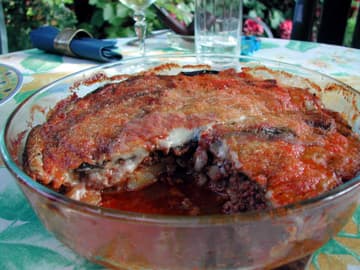
Greek moussaka is a baked dish of layers: fried aubergine, often sliced potato, a minced meat sauce with tomato, onion, cinnamon and allspice, and a thick topping of béchamel browned in the oven. Its modern form, with the béchamel, was set down by the Greek chef Nikolaos Tselementes in the 1920s.[1] Two things decide whether a slice is Halal: the mince and the wine.
The mince
The meat sauce is usually lamb or beef, and some kitchens mix in pork.[2] Lamb and beef need Halal slaughter. In Greece and Cyprus, and in Greek restaurants elsewhere, the meat is not Halal unless the restaurant says so.
The wine
Many Greek recipes add a glass of red wine to the meat sauce. This site treats a sauce cooked with wine as not Halal, because simmering lowers the alcohol without reliably removing it and the wine was added as wine.[3] Ask whether the sauce contains wine; see wine.
The rest
| Part | Halal? |
|---|---|
| Aubergine, potato, tomato, onion, spices | Yes |
| Béchamel (butter, flour, milk, egg) | Yes |
| Grated cheese on top (kefalotyri, parmesan) | See cheese for rennet |
Other moussakas
The Arab musaqa'a of Egypt, Lebanon and Syria is quite different: aubergine stewed with tomato, onion and often chickpeas, served warm or cold, sometimes with mince and never with béchamel. The vegetable version needs no check. Turkish musakka is closer to a stew of aubergine and mince.
Vegetable moussaka, made with lentils or extra vegetables instead of meat and without wine, is on many Greek menus and is the easiest order. At home, Halal lamb mince with no wine gives the classic dish. For other Greek food, see Greek salad and the Greece guide.
Where you'll find it
- Greek taverna moussaka
- Home aubergine-and-mince bakes
- Vegetarian moussaka
Frequently asked questions
Is moussaka Halal?
Does moussaka contain pork?
Is there wine in moussaka?
Is béchamel Halal?
Scholarly view
Pork mince is Haram. Lamb and beef need Islamic slaughter. Wine in the sauce is prohibited. Aubergine and béchamel do not certify the meat.
Sources
Named Islamic, certifier, manufacturer, and regulatory sources used on this page. Inline markers like [1] jump here. Retrieval dates show when we last checked the live URL. Editorial methodology.
Islamic / scriptural
-
Qur'an Retrieved
Swine prohibition if pork is mixed into the mince; slaughter rule for lamb and beef.
-
Context / background
-
Moussaka — layered aubergine and mince
Wikipedia Retrieved
Culinary identity: Greek baked layers of aubergine, spiced mince (typically lamb or beef), and béchamel; related Balkan and Levantine versions. Identity context, not a Halal certificate.

Halal-conscious recipes
A substitution-led recipe that uses this analysis.
Browse this topic
Open the parent category hub for more foods in the same group.