

Halal-conscious recipe
Seekh kebab
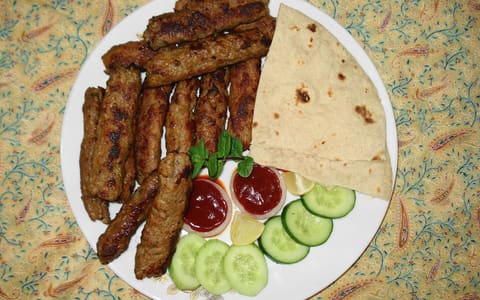
Pakistani seekh kebabs of spiced Halal beef or lamb mince pressed onto skewers and grilled, with a mince source you can trust.
Each method follows published technique for the dish, and every Halal substitution is checked against the ingredient pages we cite. Photographs come from our ingredient library rather than the finished dish.
Why Halal checks matter here
Mince is the hardest meat to trace: supermarket and frozen kebabs can be non-Halal meat or mixed on shared equipment, so the whole dish rests on where the mince came from.
Seekh means skewer, and seekh kebabs are exactly that: spiced beef or lamb mince pressed around long flat skewers and grilled over charcoal until charred at the edges. In Pakistan they are street food, restaurant food and wedding food, and the smoke from kebab grills is part of every food street from Lahore to Karachi.
The Halal question for seekh kebabs is the mince, because mince is the hardest meat to trace. Supermarket mince is rarely from Halal slaughter, frozen kebabs can mix species or use mechanically recovered meat, and even Halal meat can be minced on a machine that also handles pork. The simplest fix is a Halal butcher who minces a named cut of beef or lamb in front of you.
The technique is about moisture and fat. Squeeze the grated onion dry, keep the fat at around 20 percent, and knead the mix until it turns sticky, so it grips the skewer. Dry-roasted gram flour binds without egg.
Serve them with naan, onion rings, lemon and a mint-yogurt chutney. Raw kebabs freeze well on or off the skewer, so it is worth making a double batch.
Halal-critical ingredients
- Mince Mince is where meat is hardest to trace. Supermarket mince is rarely Halal-slaughtered, and even Halal meat can be minced on equipment shared with pork. Use a Halal butcher and ask for the cut to be minced in front of you. See Beef and Lamb.
- Frozen or takeaway kebabs Ready-made seekh kebabs can contain mechanically recovered meat, mixed species, or unnamed binders and flavourings. Buy only packs certified by a Halal body you trust, or make them at home.
- Yogurt chutney Some shop yogurt sauces are thickened with gelatin. Make chutney from plain yogurt, mint, coriander and green chilli, or read the jar.
Safe substitutes
- Supermarket mince of unknown slaughter → Halal beef or lamb, minced by a Halal butcher
- Frozen seekh kebabs without a certificate → This homemade mix, which freezes well raw on the skewer
- Egg as a binder → Roasted gram flour, as in this recipe
Allergens
none typically, egg (if using egg to bind)
Ingredients
Kebab mix
- 500 g (1.1 lb) Halal beef or lamb mince, about 20% fat
- 80 g (1 small) onion, grated and squeezed dry
- 15 g (1 tbsp) ginger-garlic paste
- 2 green chillies, finely chopped
- 10 g (¼ cup) fresh coriander, finely chopped
- 5 g (2 tbsp) fresh mint, finely chopped
- 15 g (2 tbsp) gram flour (besan), dry-roasted
- 3 g (1½ tsp) coriander seeds, toasted and crushed
- 2 g (1 tsp) cumin, ground
- 3 g (1 tsp) red chilli powder
- 2 g (1 tsp) garam masala
- 6 g (1 tsp) fine salt
To cook and serve
- 20 ml (4 tsp) oil or melted ghee, for brushing
- 1 red onion, sliced into rings
- 1 lemon lemon wedges
- 150 g (⅔ cup) mint and yogurt chutney
- 4 naan or paratha
Method
- Check and chill the mince. Buy the mince from a Halal butcher, ideally minced to order from a named cut. Keep it very cold. Seekh kebabs need fat to stay juicy, so avoid extra-lean mince; about one part fat to four parts meat is right.
- Knead the mix. Grate the onion and squeeze out as much liquid as you can in a cloth; wet onion makes the kebabs slide off the skewer. Put all the kebab ingredients in a bowl and knead for 5 minutes until the mince turns sticky and holds together. The roasted gram flour absorbs moisture and binds. Chill for 30 minutes.
- Shape on the skewers. Divide into 8 portions. With wet hands, squeeze each portion around a flat metal skewer into a long, even sausage about 2 cm thick, pressing it firmly so there are no air pockets. Pinch the ends so they grip.
- Grill hot. Grill over hot charcoal, under a very hot grill, or in a 240 °C oven on a rack, for 10–12 minutes, turning every 2–3 minutes and brushing with oil or ghee, until charred in spots and cooked through (71 °C in the centre for minced meat).
- Serve. Slide the kebabs off the skewers with a piece of naan. Serve with onion rings, lemon and mint-yogurt chutney. Shop chutneys are usually Halal-friendly, but some yogurt-based ones contain gelatin as a thickener; read the jar.
How this recipe was researched
Method specified editorially from Pakistani and North Indian seekh kebab technique (fatty mince kneaded with squeezed onion, fresh herbs and roasted gram flour, chilled, pressed around flat skewers and grilled hot) and this site's Beef, Lamb and Sausage pages. Timings follow published technique rather than a kitchen test.
Technique and ingredient sources
-
Seekh kebab — Wikipedia
Retrieved:
Spiced mince moulded on skewers and grilled over charcoal or in a tandoor.
-
Beef analysis — isithalal.food
Retrieved:
Slaughter, certification and what to ask a butcher.
-
Lamb analysis — isithalal.food
Retrieved:
Slaughter and certification for lamb and mutton.