
Are Acetic Acid and Acetates (E260–E263) Halal?
Yes — this one is Halal.
Acetic acid and its sodium, potassium, and calcium salts are Halal acidity regulators.
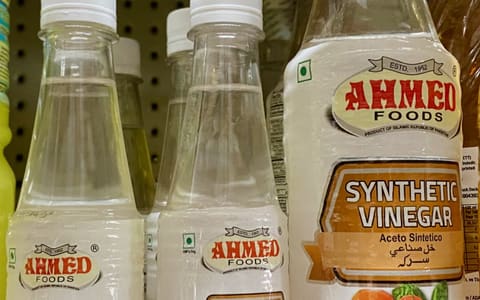
Photo: Sgroey · CC BY-SA 4.0
Additive identity
Possible source pathways
The finished molecule can be identical across feedstocks. The Halal ruling follows the pathway, not the code alone.
E260 Possible source pathways
- synthetic Halal Typical Synthetic or mineral identity. No animal tissue in the finished additive.
What decides the answer
-
E260–E263 as listed additives
Halal -
Ingredient named as wine vinegar
use the vinegar page
Where you'll find it
- Pickles and sauces
- Processed cheese
Why this ruling
Acetic acid (E260) is the acid that makes vinegar sour, and E261–E263 are its potassium, sodium and calcium salts. As listed food additives they are Halal.[2][4]
How it is made
Food-grade acetic acid is produced in two ways. Most of the world's supply is made synthetically, from methanol and carbon monoxide. The rest comes from fermentation: alcohol is converted by bacteria into vinegar, which is then concentrated. Either way, the finished additive is an acid, not an intoxicant, and US rules list it as a generally recognised food substance.[1] Certifier E-number lists put E260 with the additives that need no source check.[5]
The salts and what they do
- E261 – potassium acetate – an acidity regulator.
- E262 – sodium acetates, including sodium diacetate – the powder that gives salt-and-vinegar crisps their tang, and a preservative in baked goods and cured meats.
- E263 – calcium acetate – a mould inhibitor in bread and a firming agent.
Acetic acid itself preserves pickles, chutneys, sauces and dressings, and adds sharpness to ketchup and brown sauce.
When the label says "vinegar" instead
An additive code and the word "vinegar" are different things on a label. When an ingredient list names vinegar, the type matters and has its own discussion: spirit and malt vinegars, and wine vinegar, which some tables treat as a separate scholarly question. See vinegar, spirit vinegar and malt vinegar. "E260" or "acetic acid" on its own is covered by this page.
Related acids
For the other everyday food acids, see citric acid (E330) and the malic and fumaric acids on E296.
How to verify
- Match E260–E263 or acetic acid / sodium acetate.
- The additive is Halal.
- If the label says wine vinegar, open the vinegar page.
Quick checks
- Acetic acid and acetates are Halal acidity regulators.
- The tang on salt and vinegar crisps usually comes from sodium diacetate (E262) or vinegar powder, both Halal.
- If a label names wine vinegar, see the vinegar page.
Frequently asked questions
Is acetic acid Halal?
Is sodium acetate Halal?
Are salt and vinegar crisps Halal?
Is E260 the same as vinegar?
Scholarly view
Food-additive acetic acid is not a glass of wine. Certifiers treat E260 as Halal. Wine vinegar remains a separate scholarly discussion on some tables.
Sources
Named Islamic, certifier, manufacturer, and regulatory sources used on this page. Inline markers like [1] jump here. Retrieval dates show when we last checked the live URL. Editorial methodology.
Certifier / jurisdiction
Regulatory / labelling
-
U.S. eCFR Retrieved
U.S. identity / GRAS or colour-additive listing—not a Halal ruling.
-
Regulation (EC) No 1333/2008 on food additives
European Union Retrieved
Union-list identity—not a Halal certificate.
-
-
-
U.S. Food and Drug Administration Retrieved
US identity / labelling context—not a Halal ruling.
People also check
Related ingredients and products for this item.