Are Tartaric Acid and Tartrates (E334–E337) Halal?
Yes — this one is Halal.
Tartaric acid may be recovered from grape lees or made by other routes.
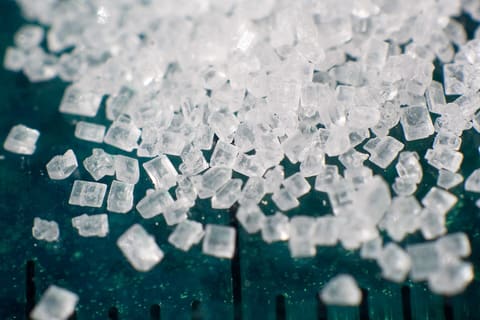
Photo: Lauri Andler (Phantom) · CC BY-SA 3.0
Additive identity
Possible source pathways
The finished molecule can be identical across feedstocks. The Halal ruling follows the pathway, not the code alone.
E334 Possible source pathways
- plant Halal Typical Botanical identity. No animal tissue is required for standard food grade.
What decides the answer
-
E334 family as food additive
Halal -
Wine / wine sauce
still alcohol
Where you'll find it
- Baking powder and sweets
- Grape-product acidity
Why this ruling
Tartaric acid (E334) is the sharp acid of grapes and tamarind. Its salts are sodium tartrates (E335), potassium tartrates (E336), including cream of tartar, sodium potassium tartrate (E337) and calcium tartrate (E354), with metatartaric acid (E353) alongside them. As food additives, all of them are Halal.[3][5]
Where it comes from
Much natural tartaric acid is recovered from the crystals and sediment that form in wine barrels and tanks during winemaking. The crystals are dissolved, purified and recrystallised. Tartaric acid can also be made synthetically. EFSA reviewed the group together,[1] and US rules list tartaric acid as a generally recognised food substance.[2]
Why a wine by-product is Halal
The question people ask is whether something recovered from wine can be Halal. Certifiers treat food-grade tartrates as Halal because the finished crystal is a different substance: it is a salt or acid, not a drink, and nothing in it intoxicates.[6] It is the same reasoning that settles cream of tartar in baking. A small number of people prefer to avoid anything from the wine industry; that is a personal choice rather than the ruling here.
That reasoning covers the additive. It does not cover wine or a sauce made with wine; see wine.
What each one does
- Cream of tartar (E336) – the acid half of many baking powders, and the pinch that keeps whisked egg whites stable for meringue.
- Tartaric acid (E334) – sourness in sweets, jellies and soft drinks.
- Sodium potassium tartrate (E337) – an emulsifying salt in some processed cheeses.
- Metatartaric acid (E353) – stops crystals forming in bottled wine; you are unlikely to meet it anywhere else.
Related acids
For the other everyday food acids, see citric acid (E330), lactic acid (E270) and acetic acid (E260).
How to verify
- Match E334–E337, E353, E354, tartaric acid, or cream of tartar.
- Halal as a food additive.
- Wine itself remains haram.
Quick checks
- Tartaric acid, cream of tartar and the tartrates are treated as Halal food acids, not wine.
- Cream of tartar is common in baking powder, meringues and some sweets.
- If you avoid wine by-products as a personal caution, ask the maker: the label will not say whether the acid came from grapes or synthesis.
Frequently asked questions
Is cream of tartar Halal?
Is tartaric acid alcohol?
Why is cream of tartar in baking powder?
What are E353 and E354?
Scholarly view
This is the same practical outcome as cream-of-tartar bakery rulings: the crystal is not wine. A minority who avoid all grape-industry streams can skip it; this site follows the mainstream Halal-additive reading.
Sources
Named Islamic, certifier, manufacturer, and regulatory sources used on this page. Inline markers like [1] jump here. Retrieval dates show when we last checked the live URL. Editorial methodology.
Certifier / jurisdiction
Regulatory / labelling
-
EFSA — Re-evaluation of L(+)-tartaric acid and tartrates (E334–E337, E354)
European Food Safety Authority Retrieved
Substance identity—not a Halal certificate for a finished pack.
-
21 CFR § 184.1099 tartaric acid
U.S. eCFR Retrieved
U.S. identity / GRAS or colour-additive listing—not a Halal ruling.
-
Regulation (EC) No 1333/2008 on food additives
European Union Retrieved
Union-list identity—not a Halal certificate.
-
-
-
U.S. Food and Drug Administration Retrieved
US identity / labelling context—not a Halal ruling.
People also check
Related ingredients and products for this item.