Additive identity
Possible source pathways
The finished molecule can be identical across feedstocks. The Halal ruling follows the pathway, not the code alone.
E479b Possible source pathways
- plant Halal Typical The named 10% fraction is soya bean oil, and plant glycerides for the remaining 90% keep the whole additive plant.
- animal Halal if verified The 90% mono- and diglyceride fraction is the same substance as E471 and is not restricted to plant sources by the specification.
- undisclosed Halal if verified Typical A pack naming E479b says nothing about which fats the glyceride fraction was made from.
How to verify
- Match E479b, INS 479(b), or TOSOM.
- Ask the manufacturer what the mono- and diglyceride fraction is made from, exactly as you would for E471.
- A Halal mark on the finished fat settles both fractions at once.
- Still verify any other glycerides listed beside it.
Quick checks
- E479b is 10% oxidised soya oil and 90% mono- and diglycerides.
- The soya part is plant by definition; the glyceride part can be plant or animal, as with E471.
- In the EU it is used only in fat emulsions for frying; a Halal or vegetarian mark settles it.
What decides the answer
-
E479b with plant-sourced glycerides confirmed
Halal -
E479b with no answer on the glyceride fraction
Halal if verified -
Finished bakery fat: still check E471/E472/E481 listed beside it
-
Soy allergy is a health issue, not a Halal ban
Why this ruling
TOSOM – thermally oxidised soya bean oil interacted with mono- and diglycerides of fatty acids – is E479b, or INS 479(b) in Codex. It is an emulsifier used almost only in frying fats and margarines, where it stops the fat spattering when it is heated in a pan.[2][3]
What it is made of
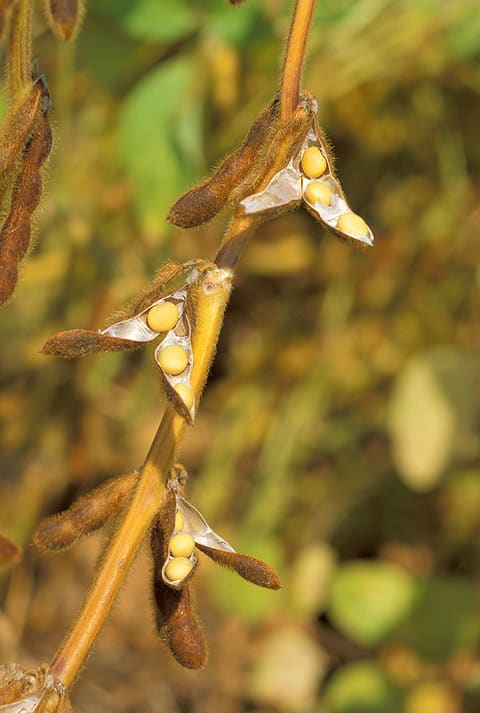
Its specification defines it as roughly 10% thermally oxidised soya bean oil and 90% mono- and diglycerides of food fatty acids.[1] The name tells you where the smaller part comes from, soya, but not the larger part.
Where the question is
The 90% part is the same substance as E471, and the specification does not require it to be plant-derived. So the ruling follows that fraction:
- Glycerides confirmed as plant-derived → Halal.
- Glycerides from a Halal-slaughtered animal → Halal.
- From pork or non-Halal slaughter → not Halal.
- No answer on the glyceride fraction → Halal if verified.
The soya in the name is sometimes taken as proof that the whole additive is plant-based. It only covers one-tenth of it.
Where you will find it
You are most likely to see E479b on frying margarines, catering fats and some spreads sold for cooking. It is rare elsewhere. On the same label you will often find other emulsifiers such as E471 and E472; each has the same question.[6]
Settling it
A vegan or vegetarian claim, or a Halal certification on the margarine, settles E479b along with the other emulsifiers. Otherwise ask the brand about the glyceride source. For margarine in general, see margarine, and for the related emulsifier family, E472. A soya allergy is a health question, not a Halal one.
Frequently asked questions
Is TOSOM animal fat?
Why the letter b?
Where is E479b used?
How do I check E479b?
Scholarly view
E479b’s legal name includes soya bean oil, which is more than an unlabelled E471 tells you — but it fixes 10% of the additive. The other 90% is mono- and diglycerides of food fatty acids, and the specification does not require those to be plant. The headline follows the fraction that is not established.
Sources
Named Islamic, certifier, manufacturer, and regulatory sources used on this page. Inline markers like [1] jump here. Retrieval dates show when we last checked the live URL. Editorial methodology.
Certifier / jurisdiction
Regulatory / labelling
-
Commission Regulation (EU) No 231/2012 — E479b specification
European Union Retrieved
The specification defines E479b as 10% thermally oxidised soya bean oil and 90% mono- and diglycerides of food fatty acids; it is not a Halal certificate.
-
Regulation (EC) No 1333/2008 on food additives
European Union Retrieved
Union-list identity—not a Halal certificate.
-
EFSA — Thermally oxidised soya bean oil interacted with mono- and diglycerides (E479b)
European Food Safety Authority Retrieved
Defined as a soya-oil reaction product with mono- and diglycerides.
-
-
People also check
Related ingredients and products for this item.