
Scholarly differences
Darul Ifta Australia (Hanafi) rules eel a type of fish and permissible, quoting al-Hidaya: 'It is permissible to eat jirreeth, eels (maarmaahi) and all types of fish and locusts without slaughtering them.' The other Sunni schools permit sea animals more broadly (IslamWeb 81789).
Ja'fari rulings permit only fish with scales, citing Imam al-Baqir, and the Imam Husain Islamic Centre lists eels as not Halal. The unagi sauce is a separate question from the animal.
Quranic guidance
-
Surah Al-Ma'idah 5:96
"Lawful to you is game from the sea and its food as provision for you and for the travelers."
What decides the answer
-
Hanafi and other Sunni rulings: eel is a permissible fish
-
Ja'fari (Shia) rulings: eel is not Halal (fish must have scales)
-
Unagi kabayaki glaze: traditionally mirin and sake; a separate check from the eel
-
Smoked or plain-cooked eel: follows the school ruling, then check brines and glazes
How to verify
- Follow your school on the eel itself.
- At sushi restaurants, ask whether the kabayaki glaze contains mirin or sake.
- Ask for unglazed grilled eel with plain soy when unsure.
- Smoked or jellied eel: check any brine or glaze for wine.
Why this ruling
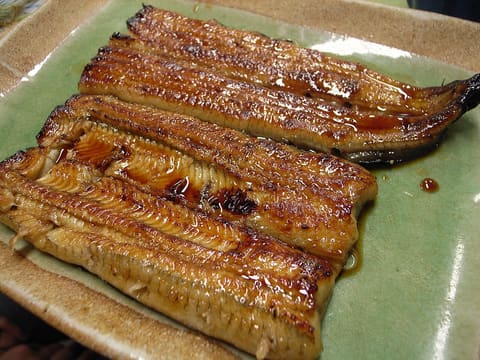
Eel is eaten across East Asia and Europe, above all as unagi, the glazed grilled freshwater eel of Japanese cooking, and as smoked eel in northern Europe. A long fish with no visible scales, it is a case where the animal itself changes status by school.
Sunni rulings: eel is a fish
Qur'an 5:96 makes the game of the sea and its food lawful.[5] The Sunni schools differ on sea animals that are not fish, and IslamWeb summarises those positions.[4] Eel is not one of the difficult cases for them, because it is a fish. Even the Hanafi school, the most restrictive on seafood, permits it: Darul Ifta Australia rules that "Eels are a type of fish. It is permissible to eat eels just like it is permissible to eat all other types of fish," quoting al-Hidaya on maarmaahi, the Arabic word for eel.[2] No slaughter is required, as with all fish.
Ja'fari rulings: fish must have scales
Ja'fari (Shia) rulings permit only fish with scales. The Imam Husain Islamic Centre quotes Imam al-Baqir, "Eat any fish that has scales, and do not eat what does not have scales," and lists eels, with catfish, among non-Halal sea foods;[3] Sayyid al-Sistani's office likewise rules that "the fish that does not have scale is forbidden".[1] Compare catfish.
The sauce is a separate check
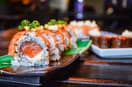
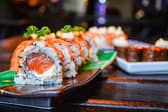
For those who permit eel, the next question is the sauce. Traditional unagi kabayaki glaze is made with mirin (sweet rice wine) and sake reduced with soy and sugar. Pre-glazed frozen eel is common in Asian groceries: flip the pack and read the ingredients. If you want unagi, ask for unglazed grilled eel with plain soy, look for an alcohol-free glaze, or make one at home with soy, sugar and ginger. See also sushi.
Smoked and jellied eel
Smoked eel and British jellied eels follow the same school ruling on the eel. Then read any brine, glaze or jelly for wine or alcohol-based flavourings.
Where you'll find it
- Unagi (grilled freshwater eel) in Japanese cuisine
- Eel sushi and donburi bowls
- Smoked eel in European cuisines
- Jellied eels (traditional British)
Frequently asked questions
Is eel Halal?
Is unagi (eel sushi) Halal?
Do eels have scales?
Is smoked eel Halal?
Is seafood inspection enough?
Sources
Named Islamic, certifier, manufacturer, and regulatory sources used on this page. Inline markers like [1] jump here. Retrieval dates show when we last checked the live URL. Editorial methodology.
Islamic / scriptural
-
Office of Sayyid Ali al-Sistani Retrieved
Ja'fari. "It is not permissible to eat from marine animals anything except fish that has scale; shrimp is considered from that category... the fish that does not have scale is forbidden."
-
Darul Ifta Australia Retrieved
Hanafi. "Eels are a type of fish. It is permissible to eat eels just like it is permissible to eat all other types of fish," quoting al-Hidaya (7/152) on maarmaahi (eel).
-
Common Halal and non-Halal sea foods
Imam Husain Islamic Centre (Sheikh Mansour Leghaei), via al-Islam.org Retrieved
Ja'fari. Quotes Imam al-Baqir, "Eat any fish that has scales, and do not eat what does not have scales" (al-Kafi 6:219), and lists eels, with catfish, as non-Halal. Read from the Internet Archive copy of 14 February 2026, as the live page blocks automated reading.
-
IslamWeb 81789 — sea creatures being Halal
IslamWeb Retrieved
Summarises the four Sunni Imams' positions on sea animals.
-