
What decides the answer
-
Fish with scales (salmon, cod, tuna, sardines...) — in every school
Halal -
Scaleless fish (catfish, eel) — per most Sunni views; avoided in Ja'fari fiqh and by some Hanafis
Halal -
Poisonous or harmful species — for all
Haram -
Shellfish and non-fish sea creatures: school-dependent - see individual entries
-
Fried or cooked fish: verify batter (beer batter is haram) and frying oil/cross-contamination
Where you'll find it
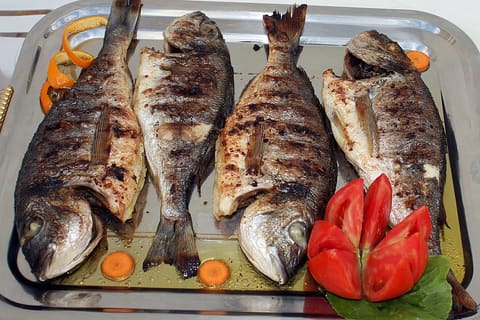
- Grilled, baked, and fried fish dishes
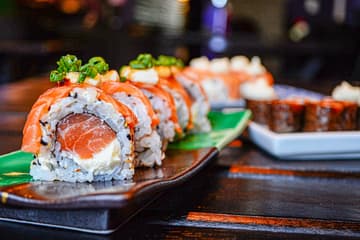
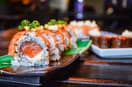
- Sushi and sashimi
- Fish and chips
- Canned tuna, salmon, and sardines
- Fish sauce and fish-based stocks
Why this ruling
Fish holds a special place in Islamic dietary law: it is the one major animal food that requires no ritual slaughter. The Quran declares the game of the sea lawful (5:96), and the Prophet (peace be upon him) said of the ocean, 'Its water is pure and its dead are lawful' - a hadith that settles both wudu at sea and dinner afterward. A fish is halal however it comes out of the water: netted, hooked, farmed, or found freshly dead.
Within that broad permission, the schools draw lines in different places. Fish with scales - salmon, tuna, cod, sardines, mackerel, tilapia, and the vast majority of what markets sell - are halal in every school of thought, Sunni and Shia, without exception. Scaleless fish such as catfish and eel are halal according to the Shafi'i, Maliki, and Hanbali schools and most Hanafi scholarship (which counts them as 'fish'), but are excluded under Ja'fari (Shia) law, which requires scales. Beyond fish proper - shrimp, crab, lobster, mollusks - the divergence widens: the majority of Sunni schools permit essentially all sea creatures, the Hanafi school restricts to fish only, and Shia law permits scaled fish plus shrimp.
What this means practically: the fish on your plate is almost never the problem - the kitchen is. Beer batter on fish and chips is haram; wine and mirin appear in seafood sauces and sushi seasonings; shared fryers cook fish alongside non-halal items; and processed seafood (imitation crab, fish balls, flavoured fillets) can carry alcohol-processed flavourings or non-halal additives. Whole fresh fish from the market carries none of these risks.
Fish is also the easy protein for Muslims eating out: in restaurants without halal meat, a grilled or baked fish dish - sauce ingredients checked - is the standard safe order. For species-by-species details, see our entries on salmon, cod, catfish, eel, and the shellfish family.
What “fish” settles—and what it does not
Scaled fish are the easiest seafood category in Islamic law: Halal across Sunni schools and in Ja'fari practice when scales are present, with no land-animal slaughter requirement. The Qur'an permits sea game (5:96). Disputes restart when the plate is shellfish (shrimp, crab, lobster), alcohol glazes, or non-Halal fryer oil—not when the fillet is plain cod, salmon, or tuna.
Processed fish products
Fish sticks, surimi, smoked fish, and frozen breaded fillets need label reads for wine, mirin, bacon bits, animal shortenings, and shared lines. Canned fish in water/oil/salt is usually clean; flavoured pouches are not. Sushi rice seasoning is typically vinegar-based; brush-on mirin/sake is the common restaurant trap.
Shopping strategy
Prefer whole fish or plain fillets when you want zero additive drama. Use Halal-certified ready meals when recipes are long. Compare species pages—salmon, tuna, cod, sardines—for product-specific notes.
How to verify
- The fish itself rarely needs verification - the preparation does.
- Ask about beer batter, wine in sauces, shared fryers with non-halal items, and non-fish ingredients (some imitation seafood contains alcohol-processed flavourings).
Quick checks
- Fish with scales needs no slaughter and is Halal.
- Ask about beer batter, wine in sauces, and fryers shared with non-Halal food.
- Imitation seafood and fish fingers can hold other ingredients; read the label.
Frequently asked questions
Does fish need to be slaughtered Islamically?
Are all fish halal in every school?
Is sushi halal?
Is fish and chips halal?
What sea creatures are haram for everyone?
Scholarly view
All schools agree that fish with scales are halal and need no slaughter - a fish is lawful however it dies once taken from the water. The differences: the Hanafi school permits only 'fish' proper (including scaleless fish like catfish and eel per many Hanafi scholars, though some restrict to scaled), while excluding shellfish; the Shafi'i, Maliki, and Hanbali schools permit virtually all sea creatures; Shia (Ja'fari) law requires scales. Harmful or poisonous species are prohibited for everyone.
Quranic guidance
-
Surah Al-Ma'idah 5:96
"Lawful to you is the game of the sea and its food, as provision for you and for travelers."
-
Surah Fatir 35:12
"...and from each you eat tender meat..."
Sources
Named Islamic, certifier, manufacturer, and regulatory sources used on this page. Inline markers like [1] jump here. Retrieval dates show when we last checked the live URL. Editorial methodology.
Islamic / scriptural
-
Retrieved
-
IslamWeb 87405 — crabs and school opinions
IslamWeb Retrieved
Names Hanafi / Maliki / Shafi‘i / Hanbali positions on crab (and analogous shellfish).
-
IslamWeb 81789 — sea creatures being Halal
IslamWeb Retrieved
Summarises four-Imam disagreement on non-fish sea animals.
-
Qur’anic text Retrieved
Lawful to you is the game of the sea and its food, as provision for you and for travelers.
-
Certifier / jurisdiction
-
Retrieved
Regulatory / labelling
-
NOAA Fisheries — fish & seafood literacy
Retrieved
People also check
Related ingredients and products for this item.
Halal-conscious recipes
A substitution-led recipe that uses this analysis.