
Scholarly differences
Roe follows its fish. The Sunni schools permit sturgeon as a fish: the Hanafi school permits all types of fish without slaughter (al-Hidaya, quoted by Darul Ifta Australia), and the Shafi'i, Maliki and Hanbali schools permit sea game broadly.
The scale requirement is Ja'fari, the Imam Husain Islamic Centre lists sturgeon among non-Halal sea foods, while Ayatollah Khomeini ruled in 1983 that sturgeon with scales near the tail are halal. Serving caviar with champagne does not change the roe; it is a separate drink question.
What decides the answer
-
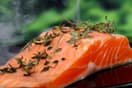
Salmon, trout and other scaled-fish roe — on every view
Halal -
Sturgeon caviar, Sunni rulings — as fish roe
Halal -
Sturgeon caviar, Ja'fari rulings — excluded by some, permitted by Khomeini's 1983 ruling
Scholarly difference -
Spreads with gelatin or unclear additives: read the label
-
Alcohol served with caviar: a separate drink ruling
How to verify
- Check the species on the jar.
- Salmon or trout roe: Halal on every view.
- Sturgeon caviar: Halal for those following Sunni rulings; some Ja'fari rulings exclude it, while others, such as Ayatollah Khomeini's, permit sturgeon with scales near the tail.
- Read spreads and substitutes for gelatin or alcohol.
- Treat champagne or vodka served with caviar as a separate drink question.
Why this ruling
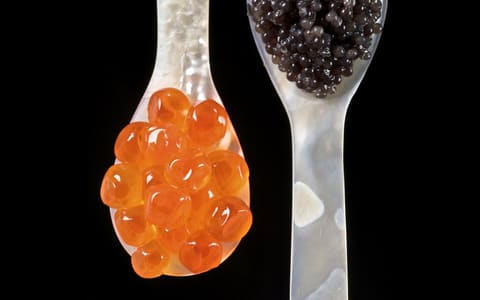
Caviar is salt-cured, unfertilized fish eggs (roe), traditionally from sturgeon species such as beluga, ossetra, or sevruga, and today often from farmed sturgeon. Related products include salmon, trout, or lumpfish roe sold under species names. It is eaten cold in small amounts on blinis, toast, or as a garnish. For Halal purposes caviar is a seafood/fish-egg question, not a land-meat slaughter question.
Roe follows its fish
Fish eggs from a permissible fish share its ruling when simply salted and packed. Classic caviar has no pork, no gelatin and no fermentation into an intoxicant, so the question is the fish.
Sturgeon and the schools
- Sunni rulings: sturgeon is a fish. The Hanafi school permits fish as a category, and Darul Ifta Australia quotes al-Hidaya permitting "all types of fish" without slaughter.[4] The Shafi'i, Maliki and Hanbali schools permit sea game more broadly still.[8] So sturgeon caviar is Halal for those following Sunni rulings.
- Ja'fari rulings: only fish with scales are permitted,[1] and Shia authorities differ on whether sturgeon qualifies. The Imam Husain Islamic Centre lists sturgeons among non-Halal sea foods, while listing salmon and trout as Halal.[5] In Iran, Ayatollah Khomeini ruled in 1983 that sturgeon with scales, "even if it is in the region of the tail", are halal, which reopened caviar to Shia buyers there.[2]
That is why this page says Scholarly difference for sturgeon caviar, while salmon and trout roe are Halal on every view. Qur'an 5:96 makes the game of the sea lawful;[3] the schools differ on what counts.
What is not the Halal issue
- Champagne, vodka, or wine service — Haram drinks served beside caviar do not chemically convert the eggs; they are a separate choice.
- Price and luxury branding — irrelevant to permissibility.
- CITES or aquaculture labels — legal and conservation controls; see trade context via sources such as cites.org (retrieved 20 July 2026). They are not Islamic certificates.
Processed spreads and substitutes
Plain salted caviar ingredient lists are short: roe, salt, sometimes a preservative. Risk rises with:
- Flavoured caviar butters and dips
- Imitation caviar using oils, colours, or gelatin
- Restaurant 'caviar' toppings mixed into cream sauces with wine
Read the label; when a restaurant cannot explain the product, skip the garnish.
Realistic verification
- Buy sealed jars that name the fish species.
- Prefer short ingredient lists.
- For sturgeon caviar, follow your school: Sunni rulings permit it; Ja'fari authorities differ.
- Decline alcohol pairings without worrying that the roe is 'contaminated by association' on the plate—still avoid shared utensils dunked in spirits if that is your caution level.
- Do not confuse fish roe with meat pâtés sold nearby in gourmet shops.
Farmed sturgeon and sushi-bar roe
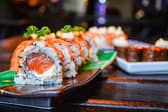
Much modern caviar is aquaculture, not wild Caspian harvest. Farming does not change the Halal analysis: it is still the same fish's eggs. Sushi bars often serve salmon ikura, flying-fish tobiko, or flavoured tobiko with chili or wasabi. Those are still fish-roe products when the label or menu is honest; dyed or oil-based imitations are not. Ask whether a bright orange topping is real roe or a starch/gel pearl. Real roe stays in the seafood lane; imitation pearls need an ingredient story.
Gift tins and airline first-class trays sometimes mix caviar with crème fraîche, blinis cooked in unclear fat, or a champagne pour. Judge each component: dairy cream is usually fine, the blini fat may not be, and the drink is separate. A Halal-friendly tasting means plain roe, verified sides, and no alcohol—not skipping the entire delicacy because someone else ordered vodka.
Where you'll find it
- Garnish on blinis or toast points
- Fine-dining appetizers
- Sushi-adjacent fish roe toppings
- Gourmet spreads and gifts
Frequently asked questions
Is caviar Halal?
Is sturgeon caviar different from salmon roe?
Does champagne make caviar Haram?
Do I need zabiha slaughter for caviar?
Are cheap 'caviar' substitutes Halal?
Sources
Named Islamic, certifier, manufacturer, and regulatory sources used on this page. Inline markers like [1] jump here. Retrieval dates show when we last checked the live URL. Editorial methodology.
Islamic / scriptural
-
Office of Sayyid Ali al-Sistani Retrieved
Ja'fari. "It is not permissible to eat from marine animals anything except fish that has scale; shrimp is considered from that category... the fish that does not have scale is forbidden."
-
-
Darul Ifta Australia Retrieved
Hanafi. Quotes al-Hidaya (7/152): it is permissible to eat all types of fish, and locusts, without slaughter.
-
Common Halal and non-Halal sea foods
Imam Husain Islamic Centre (Sheikh Mansour Leghaei), via al-Islam.org Retrieved
Ja'fari. Cites Imam al-Baqir on eating only fish with scales; lists salmon and trout as Halal and sturgeons as non-Halal. Read from the Internet Archive copy of 14 February 2026.
-
IslamWeb 87405 — crabs and school opinions
IslamWeb Retrieved
Names Hanafi / Maliki / Shafi‘i / Hanbali positions on crab (and analogous shellfish).
-
IslamWeb 81789 — sea creatures being Halal
IslamWeb Retrieved
Summarises four-Imam disagreement on non-fish sea animals.
Context / background
-
How caviar turned out to be halal
H. E. Chehabi, Gastronomica 7:2 (2007) Retrieved
History of Ayatollah Khomeini's 1983 ruling that sturgeon with scales, even near the tail, are halal, after examiners found scale-like coverings on the tail and fins; traditionalists opposed it.
-
Retrieved
People also check
Related ingredients and products for this item.