Is Harira Halal?
It depends on what the label says.
Harira is Morocco's tomato, lentil and chickpea soup, thickened with flour and usually cooked with a little lamb or beef.
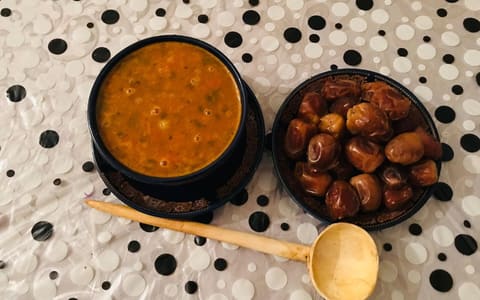
Photo: Atiqa ezahiri · CC BY-SA 4.0
How to verify
- Tomato, lentils, chickpeas, onion, celery, herbs, spices, flour and vermicelli are Halal.
- Ask whether the lamb, beef or chicken is from Halal slaughter.
- For packet mixes and stock cubes, read the label for meat extract, animal fat or flavourings of animal origin.
Quick checks
- Is the meat from Halal slaughter?
- What stock or stock cube went in?
- Packet mix: any meat extract or animal fat?
What decides the answer
-
Harira from a Moroccan home or a Muslim-run kitchen
Halal -
Vegetarian harira on water or vegetable stock
Halal -
Harira with meat or stock of unknown origin
Halal if verified -
Packet harira mix
check the label for meat extract and animal fat
Why this ruling
Harira is the soup that breaks the fast across Morocco in Ramadan, served at sunset with dates, hard-boiled eggs and chebakia, flower-shaped sesame biscuits soaked in honey.[3] A pot starts with a little lamb or beef, onion and celery, warmed with ginger, turmeric, black pepper and cinnamon. Then come tomatoes, lentils and chickpeas. Near the end, a slurry of flour and water called tadouira thickens it to a velvety body, and a handful of vermicelli or rice, coriander and parsley go in. Lemon is squeezed over at the table.[1]
What decides it
| Part | Usually | Halal? |
|---|---|---|
| Tomato, lentils, chickpeas, onion, celery | Plant | Yes |
| Ginger, turmeric, pepper, cinnamon, coriander, parsley | Plant | Yes |
| Flour (tadouira), vermicelli or rice | Wheat, rice | Yes |
| Meat | Lamb, beef or chicken, in small pieces | Only from Halal slaughter |
| Stock cube | Often added | Check for meat extract or animal fat |
| Smen (aged butter), in some homes | Dairy | Yes |
| Beaten egg, stirred in by some cooks | Egg | Yes |
The meat is the only ingredient that needs a question. In Morocco, and in Moroccan and other Muslim-run kitchens abroad, it is Halal as a matter of course. The amount is small, a few hundred grams for a large pot, but even a little meat from an unknown source decides the bowl.[2]
Packets and restaurants
Packet harira mixes are sold in Moroccan supermarkets and in North African shops in Europe. Most are lentils, dried vegetables, flour and spices, but some add meat extract, animal fat or flavourings. Read the label, or pick one with a Halal mark. The same goes for any stock cube a recipe calls for.
Outside North Africa, harira on a menu often means a Moroccan kitchen, but not always a Halal one. Ask whether the meat is Halal and what the stock is. A vegetarian harira, made on water or vegetable stock, loses little: the lentils and chickpeas carry it.
At iftar, harira usually comes before the main dish, which in many homes is a tagine. On Fridays, many Moroccan families serve couscous. For the meat itself, see lamb.
Frequently asked questions
Is harira Halal?
Why is harira eaten in Ramadan?
Can harira be made without meat?
Scholarly view
The pulses, vegetables, spices and smen (aged butter) are Halal. The meat needs Islamic slaughter, and a stock cube with meat extract or animal fat counts as meat.
Sources
Named Islamic, certifier, manufacturer, and regulatory sources used on this page. Inline markers like [1] jump here. Retrieval dates show when we last checked the live URL. Editorial methodology.
Islamic / scriptural
Context / background
-
Wikipedia Retrieved
Culinary identity: North African soup, best known in Morocco, mostly served during Ramadan. Identity context, not a Halal certificate.
-