Is Miso soup and miso paste Halal?
It depends on what the label says.
Miso paste is soybeans fermented with grain, salt and koji.
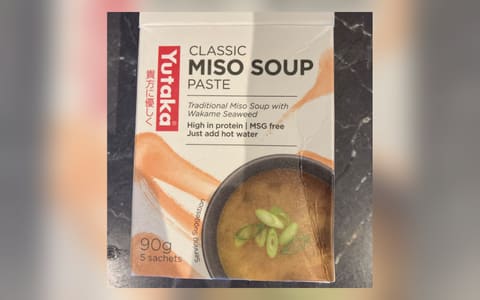
Photo: Open Food Facts contributors · CC BY-SA 3.0
How to verify
- Read the paste or sachet list for 'alcohol' or 'ethyl alcohol'.
- Pastes with only soybeans, rice or barley, salt and koji raise no question.
- Bonito (katsuobushi) in soup sachets is fish.
- In a restaurant, ask what went into the stock.
Quick checks
- Plain miso: soybeans, rice, salt, koji.
- Added alcohol: scholars differ.
- Bonito is fish.
What decides the answer
-
Miso paste of soybeans, rice or barley, salt and koji only
Halal on ingredients -
Miso paste or soup sachet with added alcohol
scholars differ; avoid if you avoid added alcohol -
Bonito (fish) in instant miso soup
no Halal question -
Restaurant miso soup
ask what went into the stock
Why this ruling
Miso is a Japanese paste of soybeans fermented with grain, salt and koji culture. It is the base of miso soup, and instant versions come as paste sachets with seaweed and stock.
Plain miso
At its simplest, miso is soybeans, grain, salt and koji. Miso Tasty Red Miso, for example, lists water, organic soybeans, organic rice, salt, yeast and koji culture, and nothing else.[1] A paste like that is Halal on its ingredients.
Pastes with added alcohol
Many pastes add alcohol. Lidl's Vitasia dark miso lists ethyl alcohol after the salt,[2] and Yutaka's wakame miso soup paste lists alcohol both in the paste and in its kelp extract.[3] Scholars differ on alcohol added to food. Darul Iftaa Chicago allows alcohol not made from grapes or dates when it is not drunk, does not make the food intoxicating, serves a legitimate purpose and is not a direct ingredient.[4] IslamQA holds that alcohol may not be added deliberately, though food in which it leaves no trace is not forbidden.[5] If you avoid added alcohol, choose a paste that lists none; see our Ethanol page for the wider question.
Bonito and dashi
Instant miso soups often add bonito powder for the stock;[3] bonito is a fish, so it is not an issue. In a restaurant, ask what went into the stock; if it uses mirin, that is a separate question. For the soy-based seasoning that sits alongside miso, see Soy sauce.
Where you'll find it
- Miso soup with tofu and wakame
- Marinades and glazes
- Ramen and noodle broths
Frequently asked questions
Is miso soup Halal?
Does miso paste contain alcohol?
Is the bonito in miso soup Halal?
Scholarly view
Fermented soybeans, rice, salt and fish raise no Halal question, so miso turns on the alcohol some makers add. Scholars differ on that. Darul Iftaa Chicago allows alcohol not made from grapes or dates in food when it is not drunk, does not make the food intoxicating, serves a legitimate purpose and is not a direct ingredient.
IslamQA holds that alcohol may not be added deliberately to food, but that food in which it leaves no trace and cannot intoxicate is not forbidden. A paste with no added alcohol avoids the question.
Sources
Named Islamic, certifier, manufacturer, and regulatory sources used on this page. Inline markers like [1] jump here. Retrieval dates show when we last checked the live URL. Editorial methodology.
Islamic / scriptural
-
Is vanilla extract halal? The Islamic ruling on alcohol in foods
Darul Iftaa Chicago (via IslamQA.org) Retrieved
'In principle, alcohol that is not produced from dates or grapes can be utilized, provided it meets the following criteria: The alcohol is not consumed directly; The end product containing alcohol does not intoxicate if consumed in a reasonable amount; The alcohol serves a legitimate purpose, such as being a solvent, and is not used as a direct ingredient; and It is not a hallmark product, generally used by non-Muslims or openly sinful individuals.'
-
IslamQA 249339 — adding alcohol to food
IslamQA Retrieved
'Alcohol is an intoxicant and subject to the same rulings as wine, so it is not permissible to deliberately add it to food, medicine, or anything else.' If it is 'so small that it is absorbed into the food, so that no trace of it remains and the one who eats or drinks a lot of this food or medicine will not become intoxicated, then there is nothing wrong with consuming it'.
Manufacturer / product
-
Miso Tasty Red Miso Paste 200 g (barcode 5060366570093)
Open Food Facts (ingredient list checked on the pack photo) Retrieved
Water, organic soybeans (29%), organic rice, salt, yeast, koji culture. Produced in Japan, packed in the UK.
-
Vitasia dark miso paste 200 g (barcode 4056489932178)
Open Food Facts (ingredient list checked on the pack photo) Retrieved
Water, soybeans, rice, salt, ethyl alcohol. Made in China for Lidl.
-
Yutaka Wakame Miso Soup Paste, 5 × 18 g (barcode 5014276432705)
Open Food Facts (ingredient list checked on the pack photo) Retrieved
Soybeans (46%), rice malt, salt, alcohol, water, yeast extract, wakame seaweed (0.6%), bonito powder (fish), kelp extract [kelp, glucose syrup, salt, alcohol, yeast extract, xanthan gum].