
How to verify
- Read the exact flavour bag—formulas differ by country.
- Plant/synthetic-only seasonings (e.g. many US Fuego packs) are widely treated as acceptable.
- Cheese/whey/“enzymes” flavours are mashbooh until enzyme source is known.
- Apply your school on any variety listing carmine/E120 (scholarly difference—see Carmine).
- Prefer Halal-certified chili snacks when you want logo-level confidence.
Quick checks
- Corn chip base is usually fine; seasoning decides.
- Watch cheese enzymes and carmine by market.
- No North America Halal cert for Takis—label each bag.
- Imported/local formulas are not interchangeable.
What decides the answer
-
Corn base is usually Halal; seasoning is the question.
-
Cheese Takis need enzyme/dairy checks.
-
Colorants and flavour carriers can vary by country.
Why this ruling
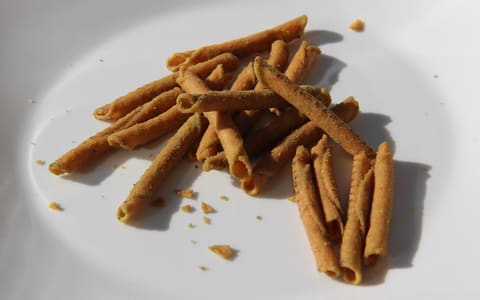
Takis are rolled corn tortilla chips made by Barcel, a subsidiary of Mexico's Grupo Bimbo, famous for their intense chili-lime 'Fuego' flavour and a lineup that now spans Blue Heat, Flare, Crunchy Fajitas, Guacamole, and various Kettlez and Waves spin-offs. Like most intensely seasoned snacks, everything rides on the seasoning powder - the chip base itself is corn masa, vegetable oil, and salt.
Takis carry no halal certification in North America, so their status comes down to flavour-by-flavour ingredient analysis. The flagship US Fuego lists corn, vegetable oils, seasoning built from chili, citric acid, sugar, monosodium glutamate, artificial colours, and similar plant-based or synthetic components - no meat, no gelatin, no dairy. On the mainstream principle that uncertified food with wholly permissible ingredients may be eaten, most Muslim consumers treat US Fuego (and similarly composed flavours) as acceptable.
The caution list starts with dairy. Flavours incorporating cheese, whey, or cream - Blue Heat has carried dairy components, and the queso and guacamole styles do - typically list 'enzymes' without specifying whether they are microbial (halal) or animal-derived from non-halal slaughter. That puts them in the classic mashbooh (doubtful) category that scholars advise stepping around when alternatives exist. Separately, some Mexican-market and limited-edition varieties have used carmine (E120), the insect-derived red dye that is a scholarly difference (follow your school; see carmine) - a reminder that the same brand name does not mean the same recipe across borders.
Practical bottom line: check the specific bag. If the ingredient list is plant-and-synthetic only, most opinions have no issue. If you see cheese, whey, unspecified enzymes, or carmine, choose another flavour - or another snack. And because Barcel reformulates and localizes recipes, a flavour that was fine last year deserves a fresh thirty-second label scan when the packaging changes.
Flavour lines and market differences
Takis (Barcel / Grupo Bimbo) sell rolled tortilla chips with aggressive chili-lime seasoning. The masa base is corn, oil, and salt; the powder carries the Halal questions. US Fuego-style lists often stay plant/synthetic; Blue Heat, queso, and guacamole styles may introduce dairy and enzymes. Carmine (E120) appears in some regional formulas—a scholarly difference on insect-derived colour (see carmine).
Company and allergen statements change; re-read when packaging updates. General snack-label literacy: fda.gov/food (retrieved 20 July 2026). Grupo Bimbo corporate information: grupobimbo.com (retrieved 20 July 2026). Compare with Doritos and Cheetos for the same seasoning logic.
Practical shopping checklist
When you pick up a bag, spend thirty seconds on the seasoning block: chili and citric acid are fine; cheese powders, whey, and unspecified enzymes deserve a pause; carmine or cochineal is a hard stop for the majority view. Travelers should not trust a US mental model in Mexico or Europe—reformulations are normal. If you want logo-level certainty, choose a Halal-certified chili snack from a Muslim grocery instead of reverse-engineering every limited edition. Pairing Takis with other unverified candy mixes (see Skittles and Doritos) multiplies label work; clearing one household staple flavour is enough for most people.
Where you'll find it
- Fuego (chili-lime) rolled tortilla chips
- Blue Heat, Flare, Crunchy Fajitas and other flavours
- Kettlez chips and Waves lines
- Snack mixes
Frequently asked questions
Are Takis Fuego Halal in the US?
Why are cheese Takis more doubtful?
Do Takis contain carmine?
Is Barcel/Grupo Bimbo Halal-certified for Takis?
Scholarly view
Barcel (Grupo Bimbo) does not halal-certify Takis in North America. For flavours whose listed ingredients are all plant-based or synthetic, the mainstream position permits them. Flavours containing cheese, whey, or 'enzymes' are doubtful because the enzyme source (animal vs microbial) is unverified - the classic mashbooh category scholars advise avoiding. Any variety listing carmine/E120 inherits the scholarly difference on insect-derived dyes—see Carmine.
Sources
Named Islamic, certifier, manufacturer, and regulatory sources used on this page. Inline markers like [1] jump here. Retrieval dates show when we last checked the live URL. Editorial methodology.
Certifier / jurisdiction
Manufacturer / product
-
Retrieved
Regulatory / labelling
-
Retrieved
Browse this topic
Open the parent category hub for more foods in the same group.