
How to verify
- Ask whether the ragout is beef, veal, or pork.
- Require Halal slaughter for any beef or veal.
- Ask whether gelatin or aspic sets the filling.
- Ask about the broth and shared fryer.
- Mustard is usually fine. In Dutch cafés, assume not Halal unless a Halal butcher or certified kitchen made them.
Quick checks
- Dutch café bitterballen are usually made with non-Halal beef or veal: treat them as not Halal until proven.
- Ask whether the ragout is set with gelatin.
- Look for Halal frozen bitterballen from Muslim butchers, or order cheese or vegetable versions from a pork-free fryer.
What decides the answer
-
Halal-slaughtered beef/veal, Halal or plant gel, pork-free fryer
Halal -
Typical unverified Dutch café plate
Halal if verified (often not Halal) -
Pork ragout or pork gelatin
Haram
Why this ruling
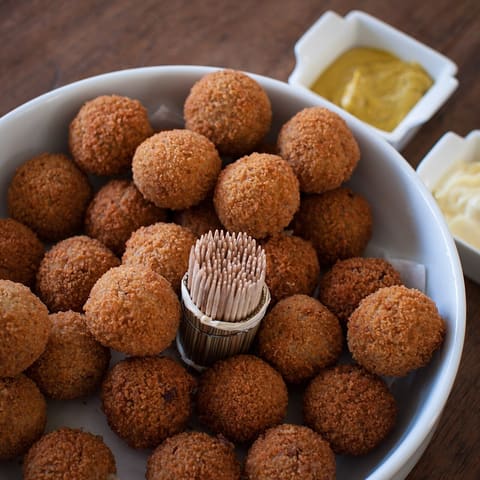
Bitterballen are the Netherlands' favourite bar snack: small balls of thick, savoury beef or veal ragout, set firm, coated in breadcrumbs and deep-fried until crisp outside and molten inside. They are served in a bowl with a pot of mustard, traditionally with a glass of bitter, the herbal gin that gave them their name.[1] Their bigger cousin, the kroket, is eaten in a bread roll or pulled from a vending wall.
Why a café bitterbal is usually not Halal
- The meat. The ragout is made from beef or veal, sometimes pork, and in ordinary Dutch cafés the meat is not from Halal slaughter.[2]
- The broth and gelatin. The ragout is thickened with a roux and meat stock, and many recipes add gelatin so it sets firm enough to roll. The gelatin source is rarely stated and may be pork.
- The fryer. The same fryer cooks frikandellen and other snacks that are often made with pork.
What is fine
The breadcrumbs and the frying oil itself are plant-based, and Dutch mustard is mustard seed, vinegar and salt; see mustard.
Halal bitterballen
Halal bitterballen and kroketten made with Halal beef and a non-pork setting agent are sold frozen by Halal brands and butchers in the Netherlands and Belgium, and Halal snack bars in Dutch cities serve them. Look for a certification mark from a recognised body; IFANCA is one example of an international certifier.[3] At a snack bar, also ask whether the fryer is shared with pork snacks.
Other Dutch snacks
For something from the same café table with no meat question, see stroopwafel. For the country's food in general, see the Netherlands guide.
Where you'll find it
- Dutch brown-café borrel snacks
- Kroket-style ragout croquettes
- Halal frozen bitterballen in some Muslim shops
Frequently asked questions
Are bitterballen Halal?
Is the mustard Halal?
Do they contain gelatin?
What can I order instead?
Scholarly view
Unnamed gelatin is treated as unverified and may be porcine. Beef broth needs Halal slaughter. Pork ragout is Haram. Mustard does not certify the filling.
Sources
Named Islamic, certifier, manufacturer, and regulatory sources used on this page. Inline markers like [1] jump here. Retrieval dates show when we last checked the live URL. Editorial methodology.
Islamic / scriptural
-
Qur'an Retrieved
Swine prohibition for pork ragout and porcine gelatin; slaughter rule for beef and veal.
Certifier / jurisdiction
-
Islamic Food and Nutrition Council of America Retrieved
Mainstream certifier practice requires a permissible gelatin source; unnamed gelatin in savoury aspic is not accepted as Halal.
Context / background
-
Bitterballen — Dutch ragout croquettes
Wikipedia Retrieved
Culinary identity: Dutch fried balls of beef or veal ragout in a roux, breaded, typically served with mustard as a café snack; related to the kroket. Identity context, not a Halal certificate.