Additive identity
Possible source pathways
The finished molecule can be identical across feedstocks. The Halal ruling follows the pathway, not the code alone.
E102 Possible source pathways
- synthetic Halal Typical Synthetic or mineral identity. No animal tissue in the finished additive.
What decides the answer
-
Listed synthetic colours in this family
Halal -
Carmine / cochineal / E120 is a separate Scholarly difference colour
-
Finished sweets: still check gelatin, shellac, flavours
Where you'll find it
- Soft drinks and confectionery
- Snack coatings
Why this ruling
The bright colours in sweets, soft drinks, icing and jelly are often synthetic dyes. The ones on this page are made by chemical synthesis, not from plants, animals or insects, and they are Halal.[3][5] Certifier E-number lists put them with the additives that need no check.[6]
The colours, with their US names
| EU code | Name | US name |
|---|---|---|
| E102 | Tartrazine | Yellow 5 |
| E104 | Quinoline yellow | – |
| E110 | Sunset yellow | Yellow 6 |
| E122 | Carmoisine (azorubine) | – |
| E124 | Ponceau 4R | – |
| E127 | Erythrosine | Red 3 |
| E129 | Allura red | Red 40 |
| E131, E132, E133 | Patent blue, indigo carmine, brilliant blue | Blue 2 (E132), Blue 1 (E133) |
| E142, E151, E155 | Green S, brilliant black, brown HT | – |
EFSA has re-evaluated these colours one by one,[1] and US rules list the certified ones such as Yellow 5.[2] Some are also sold as lakes, bound to aluminium so they do not bleed; that changes nothing.
Do not confuse them with carmine
The colour that does raise a question is carmine, also called cochineal or E120, a red made from crushed insects. Scholars differ on it. It is a natural colour, not one of these synthetics, and it is often confused with them because both give red; see carmine. Despite its name, indigo carmine (E132) is a synthetic blue and has nothing to do with insects.
Health warnings are not Halal rulings
In the EU and UK, foods containing E102, E104, E110, E122, E124 or E129 must carry a warning that they may affect activity and attention in children. Many brands have moved to plant colours as a result. That is a health matter; it does not change the Halal ruling.
The sweet still decides
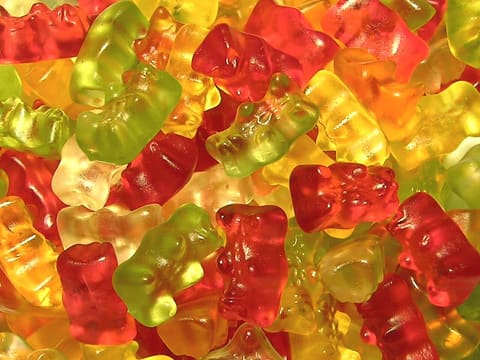
A Halal colour does not make a sweet Halal. Red gummies may be coloured with Allura red and set with gelatin; jelly desserts depend on the gelling agent; see Jell-O. For the brown colour in colas and sauces, see caramel colour (E150), and for plant colours, carotenes and annatto (E160a).
How to verify
- Match E102, E110, E129, E133 or US names Yellow 5/6, Red 40, Blue 1.
- The colour is Halal.
- If the label says carmine or E120, open that page instead.
Quick checks
- Tartrazine, Sunset Yellow, Allura Red, Brilliant Blue and the other synthetic colours here are Halal.
- They are not carmine (E120), which comes from insects.
- Sweets coloured with them may still contain gelatin or shellac.
Frequently asked questions
Is tartrazine Halal?
Is Red 40 the same as carmine?
What does “may have an adverse effect on activity and attention in children” mean?
Is Brilliant Blue Halal?
Scholarly view
Synthetic azo dyes are not a madhhab dispute. Shopper confusion is almost always carmine misread as generic red colour.
Sources
Named Islamic, certifier, manufacturer, and regulatory sources used on this page. Inline markers like [1] jump here. Retrieval dates show when we last checked the live URL. Editorial methodology.
Certifier / jurisdiction
Regulatory / labelling
-
EFSA — Re-evaluation of tartrazine (E102)
European Food Safety Authority Retrieved
Substance identity—not a Halal certificate for a finished pack.
-
21 CFR § 74.705 FD&C Yellow No. 5
U.S. eCFR Retrieved
U.S. identity / GRAS or colour-additive listing—not a Halal ruling.
-
Regulation (EC) No 1333/2008 on food additives
European Union Retrieved
Union-list identity—not a Halal certificate.
-
-
-
U.S. Food and Drug Administration Retrieved
US identity / labelling context—not a Halal ruling.
People also check
Related ingredients and products for this item.