Additive identity
Possible source pathways
The finished molecule can be identical across feedstocks. The Halal ruling follows the pathway, not the code alone.
E160a Possible source pathways
- plant Halal Typical Botanical identity. No animal tissue is required for standard food grade.
What decides the answer
-
E160a/E160b/E160e/E161b/E161g
Halal -
Paprika E160c and lycopene E160d: see E100
-
Carmine remains a separate colour
Why this ruling
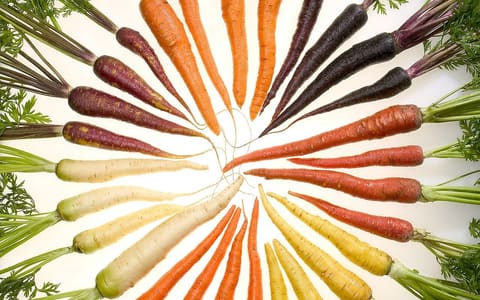
The carotenoids are the yellow, orange and red colours of carrots, marigolds and annatto seeds: carotenes (E160a), annatto (E160b), apo-carotenal (E160e), lutein (E161b) and canthaxanthin (E161g). They are Halal, and they are the colours many brands choose instead of the insect red carmine.[3][5]
Where each colour comes from
- Carotenes (E160a) – beta-carotene and mixed carotenes, the orange of carrots. Commercial supply comes from carrots, palm oil, algae, fermentation with a fungus, or synthesis identical to the natural pigment.[1][2]
- Annatto (E160b) – from the seeds of the achiote shrub, Bixa orellana, native to the tropical Americas. It is a seed colour, not an insect colour.
- Apo-carotenal (E160e) – a synthetic carotenoid with a redder orange than beta-carotene.
- Lutein (E161b) – extracted from marigold petals; a golden yellow.
- Canthaxanthin (E161g) – a red-orange carotenoid; its permitted food uses in the EU are very narrow, and it is better known as a feed ingredient that colours farmed salmon and egg yolks.
Where you will see them
Orange cheeses such as Red Leicester and Double Gloucester, and the orange of many cheddars, come from annatto. Carotenes colour margarine, soft drinks, custard powder and sweets. Lutein and apo-carotenal appear in sauces, soups and snacks.
What still needs a look
The colour is settled, but two things around it are not:
- The carrier. Carotenoids do not dissolve in water, so suppliers often sell them as beadlets or emulsions. Some carrier systems use gelatin, others use starch or gum arabic, which is one reason Halal-certified products specify their colour supplier.
- The product. An annatto-coloured cheese still depends on its rennet; a coloured sweet may still be set with gelatin.
For paprika extract (E160c) and lycopene (E160d), see the plant-colours page, E100.
How to verify
- Match E160a, E160b, E160e, E161b, E161g, carotene, or annatto.
- Halal.
- E160c paprika and E160d lycopene are on the E100 page.
Quick checks
- Carotenes, annatto, lutein, apo-carotenal and canthaxanthin are plant, algae, fermentation or nature-identical colours: Halal.
- In supplements and drink powders, carotenoids are often sold as beadlets that can use gelatin; a vegetarian or Halal label covers the carrier.
- Paprika (E160c) and lycopene (E160d) are on the E100 page.
Frequently asked questions
Is annatto Halal?
Is beta-carotene Halal?
Is lutein Halal?
Where is canthaxanthin used?
Scholarly view
Annatto is a seed colour, not an insect colour. Canthaxanthin used in food is the authorised carotenoid, not a wildlife-dye story.
Sources
Named Islamic, certifier, manufacturer, and regulatory sources used on this page. Inline markers like [1] jump here. Retrieval dates show when we last checked the live URL. Editorial methodology.
Certifier / jurisdiction
Regulatory / labelling
-
EFSA — Re-evaluation of mixed carotenes and beta-carotene (E160a)
European Food Safety Authority Retrieved
Substance identity—not a Halal certificate for a finished pack.
-
U.S. eCFR Retrieved
U.S. identity / GRAS or colour-additive listing—not a Halal ruling.
-
Regulation (EC) No 1333/2008 on food additives
European Union Retrieved
Union-list identity—not a Halal certificate.
-
-
-
U.S. Food and Drug Administration Retrieved
US identity / labelling context—not a Halal ruling.
People also check
Related ingredients and products for this item.