Additive identity
Possible source pathways
The finished molecule can be identical across feedstocks. The Halal ruling follows the pathway, not the code alone.
E170 Possible source pathways
- mineral Halal Typical Mineral or inorganic identity. Not meat, wine, or insect colour.
What decides the answer
-
E170/E172/E173/E174/E175 as mineral colour
Halal -
Decorated sweets: still check gelatin and shellac
-
E171 titanium dioxide is a sister mineral page (EU food ban is safety, not fiqh)
Where you'll find it
- Surface decoration on confectionery
- Cheese and tablet coatings
Why this ruling
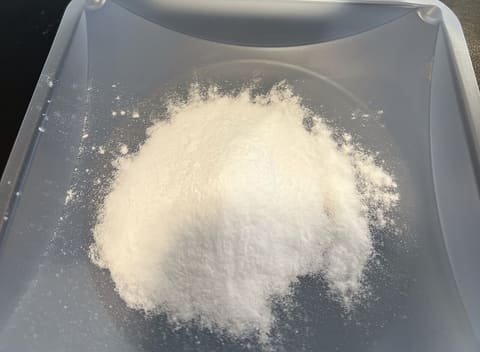
This page covers the colours made from minerals and metals: calcium carbonate (E170), iron oxides and hydroxides (E172), aluminium (E173), silver (E174) and gold (E175). None of them comes from an animal, a plant extract or alcohol, and all of them are Halal as additives.[3][5] Certifier E-number lists put them with the additives that need no check.[6]
What each one is used for
| Code | What it is | Where you see it |
|---|---|---|
| E170 | Calcium carbonate, the mineral in chalk and limestone | White coatings on sweets, chewing gum, calcium-fortified foods, flour |
| E172 | Iron oxides, the pigments of rust and ochre | Red, yellow, brown and black on tablet coatings and some sweets |
| E173 | Aluminium powder | Silver decoration on cake sweets, in small amounts |
| E174 | Silver | Silver dragées and cake decorations |
| E175 | Gold | Gold leaf and flakes on chocolates, cakes and some drinks |
Calcium carbonate is also a nutrient and a raising and firming agent. It is one of the white colours that replaced titanium dioxide in Europe; see E171. EFSA has re-evaluated it for food use,[1] and US rules list it as a generally recognised food substance.[2]
Gold and silver leaf
The pigment is not the question here. What some people ask is whether eating gold and silver is right at all, and the answers we have found are conditional and attributed:
- IslamWeb (fatwa 371467, 2018) permits sweets decorated with gold or silver leaf "as long as there is no extravagance or exaggeration, provided there is no harm", citing Shaykh 'Abdur-Rahmaan Al-Barraak. It notes that it found no statement from the early scholars on the question.[7]
- Darul Iftaa Mahmudiyyah (Hanafi, Lusaka) says eating things like gold unnecessarily is disliked because they may harm the body, but permits edible gold on desserts "in minute quantities with certainty that one's health will not be affected".[8]
Both answers carry conditions: no extravagance, no harm, small amounts. That is a question about the decoration, not the additive, and people follow their own scholars on it.
What the colour does not tell you
A mineral colour on a sweet says nothing about the rest of it. Silver balls sit on icing that may contain gelatin, gold leaf sits on chocolates that may have liqueur centres, and coloured coatings sit on sweets that may have shellac or carmine as well. See gelatin, shellac and carmine. For the synthetic colours, such as tartrazine, see E102.
How to verify
- Match E170, E172, E173, E174, E175, calcium carbonate, iron oxides, gold, or silver.
- The pigment is Halal.
- Read the rest of a decorated sweet.
Quick checks
- Calcium carbonate, iron oxides, aluminium, silver and gold are mineral colours: Halal.
- Gold or silver on a cake or chocolate is only the decoration; check what it sits on.
- Titanium dioxide (E171) has its own page.
Frequently asked questions
What is E170 in food?
Is calcium carbonate Halal?
Is gold leaf on chocolates Halal?
What are iron oxides used for?
Are silver balls on cakes Halal?
Scholarly view
The additive question and the eating question are separate. As additives, these are mineral and elemental pigments with no animal tissue in them. Whether to eat gold and silver leaf is a fiqh question with named, conditional answers: IslamWeb (fatwa 371467) permits vark sweets if there is no extravagance and no harm, and notes it found no statement from the early scholars; Darul Iftaa Mahmudiyyah (Hanafi, Lusaka) permits edible gold in minute quantities when one is certain it will not affect one's health. Follow your own scholar on the decoration.
Sources
Named Islamic, certifier, manufacturer, and regulatory sources used on this page. Inline markers like [1] jump here. Retrieval dates show when we last checked the live URL. Editorial methodology.
Islamic / scriptural
-
Eating vark sweets (fatwa 371467)
IslamWeb Retrieved
Dated 26 February 2018. Permits sweets decorated with edible silver or gold leaf "as long as there is no extravagance or exaggeration, provided there is no harm", citing Shaykh 'Abdur-Rahmaan Al-Barraak; says it found no statement from the early scholars on it.
-
Darul Iftaa Mahmudiyyah, Lusaka (via IslamQA.org) Retrieved
Hanafi. Answered by Bilal Yusuf Pandor, checked by Mufti Nabeel Valli. Says it is disliked to eat things like gold unnecessarily because they may harm the body, but permissible "in minute quantities with certainty that one's health will not be affected".
Certifier / jurisdiction
Regulatory / labelling
-
EFSA — Re-evaluation of calcium carbonate (E170)
European Food Safety Authority Retrieved
Substance identity—not a Halal certificate for a finished pack.
-
21 CFR § 184.1191 calcium carbonate
U.S. eCFR Retrieved
U.S. identity / GRAS or colour-additive listing—not a Halal ruling.
-
Regulation (EC) No 1333/2008 on food additives
European Union Retrieved
Union-list identity—not a Halal certificate.
-
-
-
U.S. Food and Drug Administration Retrieved
US identity / labelling context—not a Halal ruling.
People also check
Related ingredients and products for this item.