
Additive identity
Possible source pathways
The finished molecule can be identical across feedstocks. The Halal ruling follows the pathway, not the code alone.
E572 Possible source pathways
- plant Halal Typical Fatty acids from palm, soy, sunflower, or other vegetable oils.
- animal Halal if verified The same esters can be split from tallow or lard. Pork or non-zabiha fat is haram.
- undisclosed Halal if verified Typical Most labels print only the E-number or US name. Treat as mashbooh until a plant, vegan, or Halal claim settles the fat.
How to verify
- Match magnesium stearate, vegetable stearate, E572, INS 572, or aluminium/aluminum stearate (E573).
- 'Vegetable stearate' or Halal-certified capsules settle it.
- Related food salts are E470a/b; free acids are E570.
Quick checks
- Magnesium stearate is magnesium plus stearic acid; the stearic acid can be palm or tallow.
- “Vegetable magnesium stearate” on the label settles it.
- A Halal-certified supplement settles it and the capsule shell together.
What decides the answer
-
Vegetable stearate or Halal-certified tablet
Halal -
Pork or non-zabiha tallow stearate
haram -
Unspecified magnesium stearate / E572
Halal if verified -
Capsule shells (gelatin vs HPMC) are a separate check
Why this ruling
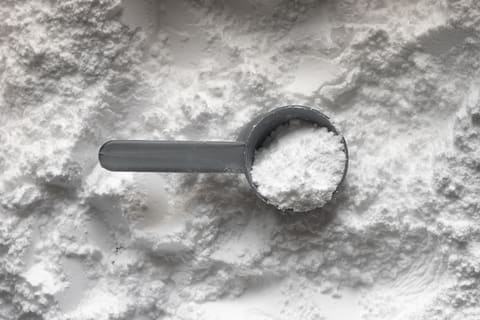
Magnesium stearate is the white powder that keeps tablet mixtures flowing through machines and stops them sticking to the press. It is in a very large share of vitamins, supplements and medicines, and it is one of the most searched Halal ingredients. Codex numbers it INS 572, older EU paperwork used E572, and E573 is the related aluminium stearate.[4][2]
Where the question is
Magnesium stearate is magnesium joined to stearic acid. The metal is a mineral and raises no question. Stearic acid is a fatty acid, and it can come from vegetable fats, usually palm, or from animal fat such as beef tallow. So the ruling follows the fat:
- Vegetable stearic acid → Halal.
- From a Halal-slaughtered animal → Halal.
- From pork or non-Halal slaughter → not Halal.
- Not stated → Halal if verified.
Certifier lists put unsourced stearates in the doubtful group.[5] It is not right to say that all magnesium stearate is Haram, or that all of it is from palm.
Not a current EU food additive
E572 is not on the current EU list of permitted food additives,[1] so you will rarely see it on European food labels. It appears on supplements and medicines, where it is listed by name, and on US products.
How to check a supplement
- Look for "vegetable magnesium stearate" or "magnesium stearate (vegetable source)" on the label.
- A vegan or Halal-certified supplement settles it.
- Otherwise ask the brand; most supplement makers answer this question routinely.
- Check the capsule too: it may be gelatin rather than HPMC; see gelatin and cellulose (E460).
For stearic acid itself, see E570, and for the related salts used in food, E470.
Where you'll find it
- Tablet and capsule flow agent
- Confectionery anti-caking (legacy / non-EU)
Frequently asked questions
Is magnesium stearate Halal?
Why is magnesium stearate in supplements?
Is E572 allowed in EU food?
What about aluminium stearate (E573)?
Scholarly view
Magnesium stearate is one of the most searched Halal supplement ingredients. The metal is not the issue; stearic acid is. It is neither always Haram nor always from palm; the source decides.
Sources
Named Islamic, certifier, manufacturer, and regulatory sources used on this page. Inline markers like [1] jump here. Retrieval dates show when we last checked the live URL. Editorial methodology.
Certifier / jurisdiction
-
SANHA Retrieved
Source-dependent additives listed mashbooh pending origin.
Regulatory / labelling
-
Regulation (EC) No 1333/2008 on food additives
European Union Retrieved
Union-list identity—not a Halal certificate.
-
U.S. Food and Drug Administration Retrieved
US identity / labelling context—not a Halal ruling.
-
-
People also check
Related ingredients and products for this item.