
Additive identity
Possible source pathways
The finished molecule can be identical across feedstocks. The Halal ruling follows the pathway, not the code alone.
E412 Possible source pathways
- plant Halal Typical Endosperm of guar beans. No animal tissue.
What decides the answer
-
Plain guar gum / E412
Halal -
Blends with other gums
still plant-based unless animal additives are listed -
Finished products
verify gelatin, emulsifiers, flavours separately
Why this ruling
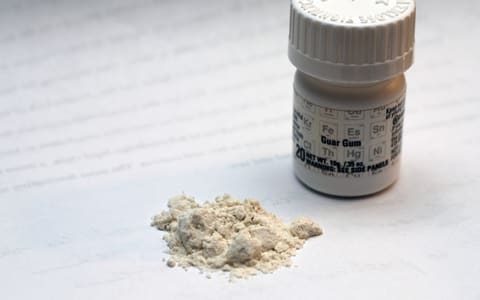
Guar gum is a cream-coloured powder made from the endosperm of the guar bean (Cyamopsis tetragonoloba), a drought-tolerant legume grown heavily in India and Pakistan. Split, milled, and sieved, the gum hydrates in cold water to give high viscosity—hence its job as a thickener and ice-crystal stabiliser. In Europe it is labelled E412.
On the shelf
Sold on its own, guar gum is a single ingredient: Bob's Red Mill's lists just "Guar gum."[3] In foods it appears as guar gum or E412 in the thickener line.
Plant chemistry (why the ruling is clean)
Guar gum is a galactomannan polysaccharide—plant carbohydrate storage material—not a protein scraped from hides. The U.S. FDA lists guar gum as GRAS for use as a stabiliser and thickener in 21 CFR § 184.1339 (retrieved 20 July 2026). EFSA’s re-evaluation of guar gum (E 412) likewise defines it as the ground endosperm of guar seeds (see EFSA Journal opinion on E 412, e.g. doi:10.2903/j.efsa.2017.4669, retrieved 20 July 2026).
| Gum | Source | Default Halal status |
|---|---|---|
| Guar (E412) | Guar bean | Halal |
| Xanthan (E415) | Bacterial fermentation on plant sugars | Halal (usual food grade) |
| Pectin (E440) | Fruit | Halal |
| Carrageenan (E407) | Seaweed | Halal |
| Gelatin (E441) | Animal collagen | Depends on species/slaughter |
Where you meet it
Ice cream, yogurt drinks, bottled sauces, gluten-free bread, and plant-based milks use guar alone or with xanthan/locust bean gum. Muslim-majority manufacturers often prefer these plant gums to avoid gelatin. That habit does not make every ice cream Halal worldwide—dairy emulsifiers or non-Halal flavourings can still appear beside E412.
For certified finished goods in Malaysia, use JAKIM’s Portal Halal / MYeHALAL (retrieved 20 July 2026) rather than inferring from “contains guar gum” alone.
Guar vs other pantry gums
Home bakers often keep guar beside xanthan. Guar hydrates quickly and builds viscosity in cold liquids; xanthan is a fermentation gum with different stretch and syneresis behaviour. Locust bean gum (carob) is another plant galactomannan sometimes blended with guar in ice cream. All three are plant or microbial-on-plant systems and do not inherit gelatin’s slaughter questions. Buying a “gluten-free gum blend” is still fine for the gum fraction—read whether the blend also adds dairy powders or flavourings.
Industrial oilfield or non-food guar grades are not kitchen ingredients. Stick to food-labelled powders. Digestive sensitivity to high-fibre gums is a personal health issue; it does not flip the Halal ruling to Haram.
Realistic verification
- Find guar gum / E412 on the ingredient list.
- Confirm gelatin is absent if you need a gelatin-free dessert.
- For certified Halal ice cream or sauce, trust the mark for the whole formula.
- In home baking, pure guar powder from the baking aisle is a plant binder you control.
How to verify
- Confirm the label lists guar gum or E412—not gelatin.
- In multi-ingredient ice cream or sauces, still check emulsifiers, gelatin, and alcohol flavourings separately.
- Prefer Halal-certified finished foods when the whole formula is unclear.
- Supplement powders using guar as fibre should still be checked for capsule shells and flavour blends.
Frequently asked questions
Is guar gum Halal?
What is E412?
Is guar gum the same as gelatin?
Does processing guar gum use alcohol?
Is guar gum safe to assume in every ice cream?
Scholarly view
Guar gum is ground guar endosperm—legume carbohydrate, not an animal hydrocolloid. Halal authorities treat E412 like other plant gums (xanthan, pectin) without slaughter investigation. Residual questions almost always belong to co-ingredients in ice cream or sauces, not to guar itself. Allergies or digestive tolerance are health topics, not fiqh bans.
Sources
Named Islamic, certifier, manufacturer, and regulatory sources used on this page. Inline markers like [1] jump here. Retrieval dates show when we last checked the live URL. Editorial methodology.
Certifier / jurisdiction
-
Retrieved
Manufacturer / product
-
Bob's Red Mill guar gum (0039978025548)
Open Food Facts (pack record) Retrieved
Record updated June 2026; kosher parve label recorded. Ingredients: 'Guar gum.'
Regulatory / labelling
-
Retrieved
People also check
Related ingredients and products for this item.