
Additive identity
Possible source pathways
The finished molecule can be identical across feedstocks. The Halal ruling follows the pathway, not the code alone.
E440 Possible source pathways
- plant Halal Typical Fruit polysaccharide from citrus peel or apple pomace. SANHA lists E440(a) as Halaal with a cider-source check. Amidated E440(b) is Mushbooh on SANHA’s list.
What decides the answer
-
Plain pectin / E440i from citrus or apple — as an ingredient (SANHA E440(a) Halaal; check cider source)
Halal -
Amidated pectin / E440ii: SANHA lists E440(b) as Mushbooh—verify process or prefer E440i
-
Finished products: SANHA’s additive listing is not a certificate for the jam or gummy; still verify co-ingredients
Where you'll find it
- Jams, jellies, and fruit preserves
- Fruit fillings and confectionery gels
- Yogurt drinks and fruit beverages
- Gelatin-free gummies and desserts
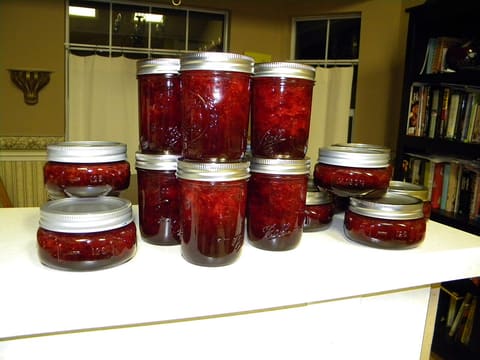
- Home canning and jam-setting powders
Why this ruling
Pectin is the plant world’s answer to gelatin: a soluble fibre that lives in fruit cell walls and, when extracted and cooked with sugar and acid, sets jams and jellies into a clean gel. Commercially it is coded E440 (pectin) or split as E440i (pectin) and E440ii (amidated pectin). The culinary job is thickening and gelling; the Islamic job is simpler than gelatin’s because the starting material is fruit, not skin or bone—provided you use the named additive ruling, not a slogan about unnamed certifiers.
Source and chemistry (why standard pectin is Halal here)
Food manufacturers extract pectin mainly from citrus peel and apple pomace (and sometimes beet pulp) with hot dilute acid, then filter and precipitate the polymer. The U.S. FDA’s GRAS listing at 21 CFR § 184.1588 describes that plant extraction pathway (retrieved 25 August 2026). Industry bodies such as the International Pectin Producers Association summarise the same point for consumers: pectin is fruit fibre labelled E440, not an animal product (pectinproducers.com, retrieved 25 August 2026).
SANHA’s E-number page lists E440(a) Pectin as Halaal, source “apple residues from cider making & orange pith,” with the instruction to check that the source is not from cider making (sanha.org.za/2009/12/17/e440a-pectin, retrieved 25 August 2026). That named listing is this page’s Halal evidence for standard pectin. SANHA lists E440(b) Amidated Pectin as Mushbooh (treatment of pectin with ammonia; same cider check) (sanha.org.za/2009/12/17/e440b-amidated-pectin, retrieved 25 August 2026). Amidation does not import collagen, but this site does not treat E440ii as automatically Halal against that listing.
Gelatin labelling — do not copy an E441 error
| Ingredient | Typical source | Default on this page |
|---|---|---|
| Pectin (E440 / E440i) | Citrus / apple (plant) | Halal (SANHA E440(a)) |
| Amidated pectin (E440ii) | Plant pectin treated with ammonia | Mushbooh on SANHA’s E440(b) list |
| Agar-agar (E406) | Seaweed | Halal |
| Carrageenan (E407) | Seaweed | Halal |
| Gelatin | Pork, beef, or fish | Depends on species / slaughter |
If a gummy or marshmallow lists gelatin or gelatine, follow the gelatin page. If it lists pectin, the gelling agent itself is not animal collagen.
Do not tell EU shoppers that gelatin is E441. Regulation (EC) No 1333/2008 (retrieved 25 August 2026) treats edible gelatin as a food ingredient, not an authorised additive E-number on the current Union list. US labels typically print “gelatin” with no E-number. Glycerin is E422, a different additive—do not recycle that glycerin/E441 mix-up here.
Markets and finished foods
Pectin is ubiquitous in EU and North American preserves, fruit yogurts, and many “vegetarian jelly” candies. Muslim-majority markets often prefer pectin- or agar-set sweets precisely to avoid porcine gelatin. That market habit does not make every fruit candy Halal worldwide: a European pectin jam can still carry wine flavouring, and a U.S. gummy can still use pork gelatin in a different product. SANHA’s E440(a) page is an ingredient ruling; it does not certify the finished jar.
Home cooks meet pectin as powdered “jam sugar,” liquid pectin pouches, or low-sugar pectin blends. Those pantry products are plant gels; flavoured dessert mixes in the same aisle may still hide gelatin—read each box.
Realistic verification
- Find “pectin,” “fruit pectin,” or “E440” on the ingredient line.
- Confirm gelatin is absent by name if you need a gelatin-free product.
- If the list says amidated pectin / E440ii, treat it as Mashbooh on SANHA’s E440(b) listing unless you have another named ruling or a Halal mark on that product.
- For certified Halal candy, trust the certifier mark for the whole formula, not pectin alone.
How to verify
- Confirm the ingredient is listed as pectin, fruit pectin, or E440/E440i.
- SANHA lists amidated pectin (E440(b)/E440ii) as Mushbooh—verify that process or prefer non-amidated pectin.
- Look for gelatin by name; current EU additive law does not number gelatine as E441.
- In multi-ingredient jams or gummies, still check other additives (gelatin, emulsifiers, alcohol flavourings) separately.
- SANHA’s E440 listing does not certify the finished sweet.
Frequently asked questions
Is pectin the same as gelatin?
Is E440 Halal?
Does alcohol used to precipitate pectin make it Haram?
Is amidated pectin (E440ii) the same ruling?
Is pectin safe to assume in every jam?
Scholarly view
Pectin is plant cell-wall material. SANHA lists E440(a) as Halaal (apple residues from cider making and orange pith—check that the source is not from cider making) and E440(b) amidated pectin as Mushbooh (ammonia treatment; same cider check).
Those are named additive rulings, not a blanket claim that unnamed certifiers accept E440 and alcohol-contact processing. Current EU Regulation 1333/2008 treats edible gelatin as a food ingredient, not an authorised E-number; do not tell shoppers to hunt E441 for gelatin the way E440 marks pectin, and do not confuse gelatin with glycerin (E422).
Sources
Named Islamic, certifier, manufacturer, and regulatory sources used on this page. Inline markers like [1] jump here. Retrieval dates show when we last checked the live URL. Editorial methodology.
Certifier / jurisdiction
-
SANHA Retrieved
Status: Halaal. Source: apple residues from cider making and orange pith. Check that source is not from cider making.
-
SANHA — E440(b) (Amidated Pectin)
SANHA Retrieved
Status: Mushbooh. Source: treatment of pectin with ammonia. Check that source of pectin is not from cider making.
Manufacturer / product
-
International Pectin Producers Association
Retrieved
Industry identity: pectin is fruit fibre labelled E440, not an animal product.
Regulatory / labelling
-
21 CFR § 184.1588 — pectins (FDA GRAS)
Retrieved
Plant extraction pathway; food-safety identity, not a Halal fatwa.
-
Regulation (EC) No 1333/2008 — EU food additives
Retrieved
EU additive framework. Edible gelatin is listed among food ingredients, not as an authorised E-number. Do not publish E441 as the current EU code for gelatin.
People also check
Related ingredients and products for this item.