
Additive identity
Possible source pathways
The finished molecule can be identical across feedstocks. The Halal ruling follows the pathway, not the code alone.
E310 Possible source pathways
- synthetic Halal Typical Synthetic or mineral identity. No animal tissue in the finished additive.
What decides the answer
-
These antioxidant codes
Halal -
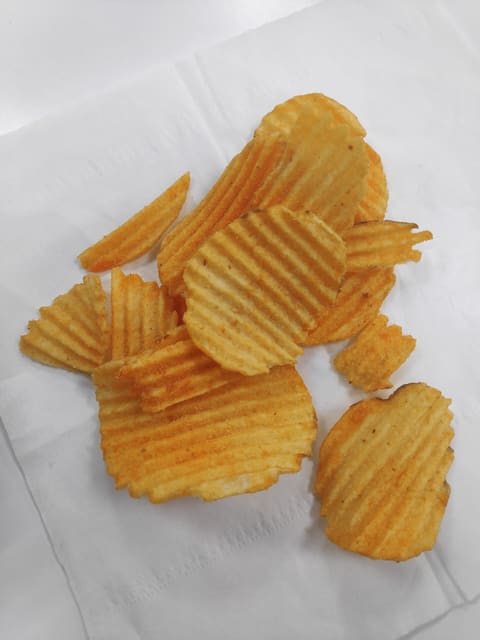
Finished snack: still check animal fat, gelatin, and flavour
Where you'll find it
- Fried snacks and chewing gum
- Cured-meat colour retention (erythorbate)
Why this ruling
Fats and oils go rancid when they react with oxygen. Antioxidant additives slow that down, which is why they appear on so many snack and frying-oil labels. This page covers the synthetic ones and the plant extract that increasingly replaces them. All of them are Halal.[3][5]
The codes on this page
| Code | Name | Typical use |
|---|---|---|
| E310 | Propyl gallate | Frying oils, chewing gum |
| E315, E316 | Erythorbic acid, sodium erythorbate | Cured meats, frozen fish |
| E319 | TBHQ | Frying oils, instant noodles, crackers |
| E320 | BHA | Fats, chewing gum, seasonings |
| E321 | BHT | Chewing gum, fats, some cereal packaging |
| E392 | Rosemary extract | Oils, meat products, snacks |
BHA, BHT, TBHQ and the gallates are made by chemical synthesis. Erythorbates are made by fermenting sugar. Rosemary extract comes from the leaves of the herb. None has an animal input, and certifier lists put them with the additives that need no check.[6]
Health questions are not Halal questions
BHA and TBHQ in particular attract health debates. EFSA and US regulators set limits on how much may be used,[1][2] and some brands now use rosemary extract or vitamin E (E306) instead. Whatever someone decides about that, it does not change the Halal ruling on the additive.
What they tell you about the food
Very little. An antioxidant on a crisp packet protects the oil; it does not tell you whether the seasoning contains meat powder, cheese made with animal rennet or other checks. On a sausage or ham, sodium erythorbate sits next to nitrite as part of the cure, just as vitamin C (E300) does. It says nothing about the meat or its slaughter; see nitrites (E250).
Look instead at the fat itself (vegetable oil or animal fat), and the other named ingredients. For a worked snack example, see Pringles. For noodles, where TBHQ is common, see ramen.
How to verify
- Match E310, E315, E316, E319–E321, E392, BHA, BHT, TBHQ, or rosemary extract.
- Halal.
- Animal fat in the same snack is a separate line.
Quick checks
- BHA, BHT, TBHQ, the gallates, erythorbates and rosemary extract are antioxidants: Halal.
- They protect the frying oil; they do not tell you what the oil is.
- Rosemary extract (E392) is a plant extract.
Frequently asked questions
Is BHT Halal?
Is TBHQ Halal?
Is rosemary extract Halal?
Is sodium erythorbate in meat Halal?
Scholarly view
Erythorbate in ham is not a slaughter certificate. Rosemary extract is a plant antioxidant, not a flavour-alcohol loophole.
Sources
Named Islamic, certifier, manufacturer, and regulatory sources used on this page. Inline markers like [1] jump here. Retrieval dates show when we last checked the live URL. Editorial methodology.
Certifier / jurisdiction
Regulatory / labelling
-
EFSA — Re-evaluation of butylated hydroxyanisole (E320)
European Food Safety Authority Retrieved
Substance identity—not a Halal certificate for a finished pack.
-
U.S. eCFR Retrieved
U.S. identity / GRAS or colour-additive listing—not a Halal ruling.
-
Regulation (EC) No 1333/2008 on food additives
European Union Retrieved
Union-list identity—not a Halal certificate.
-
-
-
U.S. Food and Drug Administration Retrieved
US identity / labelling context—not a Halal ruling.
People also check
Related ingredients and products for this item.