
How to verify
- Read the exact flavour’s ingredient list for cheese, meat, E627/E631/E635, and E471.
- Reject bacon/ham/pork-named products.
- Look for a Halal logo on regional cans (Malaysia/Gulf).
- Confirm Malaysian products via JAKIM’s portal when you need directory-level proof—do not treat a KL can as approval for a London can.
What decides the answer
-
Pork/bacon-labelled flavours
Haram -
Original/plain styles are often clearer than cheese or meat flavours
-
Seasoning blends decide mashbooh risk—not the can shape
-
Country formulas differ
Why this ruling
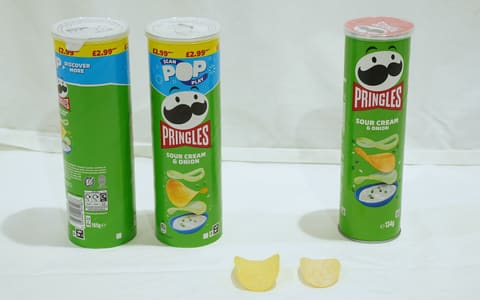
Pringles are stackable potato crisps made from a dough of dehydrated potato and starches, fried, seasoned, and packed in the famous cylindrical can. Ownership moved from Procter & Gamble to Kellogg’s and now sits with Kellanova, but the Halal question never was “who owns the tube?”—it is which country’s seasoning and which Halal mark (if any).
Dough vs dust
The reformed crisp body—potato flakes, rice/corn/wheat starches, vegetable oil—is ordinarily plant-based. Seasoning decides the ruling:
- Salt-only / Original systems (simplest)
- Cheese and sour-cream dairy powders
- Flavour enhancers E627 / E631 / E635
- Emulsifier E471 (plant or animal unless audited)
- Meat, bacon, or local savoury concepts
Brand pages such as pringles.com (retrieved 20 July 2026) describe flavours by market; they are not a worldwide Halal certificate.
Malaysia vs Western cans (why rumours spread)
A widely shared claim alleged lard in Pringles. Malaysian authorities and the local manufacturer emphasised that Pringles made in Malaysia for local/ASEAN sale were JAKIM-certified and not the same as rumoured foreign formulas. A manufacturer notice preserved at HalalFocus states P&G Malaysia’s made-in-Malaysia Pringles received JAKIM certification for listed flavours produced in Johor (halalfocus.com/are-all-pringles-halal, retrieved 20 July 2026). Contemporary buyers should still verify the current can logo and, when needed, JAKIM’s Portal Halal / MYeHALAL (retrieved 20 July 2026).
| Market | Typical pattern |
|---|---|
| Malaysia (local make) | Halal-certified flavours when logo present |
| Gulf domestic products | Often local Halal marks—check can |
| US / UK / EU | Generally not Halal-certified; flavour-dependent |
Why status is Market-dependent
Market-dependent means: potato dough is fine; seasoning and missing Western certification are not uniform. Certified-market cans can be treated as Halal for that product. Western cans require label-by-label judgement—or a switch to a marked alternative.
Reading a Pringles can like a Halal checklist
Start with the flavour banner, then the ingredient list in tiny type near the barcode. Note vegetable oils (usually fine), then jump to the seasoning block. Cheese powders, milk derivatives, flavour enhancers, and E471 are the usual pause points. “Vegetarian” claims—if present in your market—exclude some animal rennet concerns but still are not Halal certification. Travel cans and duty-free multipacks often mix factories; the country printed as manufactured-in beats the language on the marketing sleeve.
Sharing tubes at parties create a practical issue: once several flavours sit open, people lose track of which can was the certified import. Keep Halal-marked cans labelled if you rely on certification. For strict households, Original or a verified Halal regional flavour is simpler than chasing every BBQ variant.
Realistic verification
- Flavour name (reject pork/bacon).
- Full seasoning list including E-numbers.
- Country of manufacture + Halal logo.
- Limited editions reset the check.
Where you'll find it
- Canned stackable crisps as snacks
- Party sharing cans and flavour rotations
- Crushed toppings in casual recipes
- Regional limited-edition seasonings
Frequently asked questions
Are Pringles Original Halal?
Are Pringles Halal in Malaysia?
Do UK or US Pringles contain lard?
Which flavours are highest risk?
Who owns Pringles now?
Scholarly view
Pringles are reformed potato crisps, not sliced chips—the Halal analysis still tracks oil and seasoning, not the hyperbolic-paraboloid shape. Historical P&G Malaysia statements and JAKIM confirmation addressed viral ‘lard in Pringles’ rumours for locally made cans: Malaysian production was certified and not the UK recipe. That episode is why market-of-manufacture matters more than brand folklore.
Sources
Named Islamic, certifier, manufacturer, and regulatory sources used on this page. Inline markers like [1] jump here. Retrieval dates show when we last checked the live URL. Editorial methodology.
Certifier / jurisdiction
-
Retrieved
Manufacturer / product
-
Retrieved
-
Retrieved
People also check
Related ingredients and products for this item.

Browse this topic
Open the parent category hub for more foods in the same group.