Additive identity
Possible source pathways
The finished molecule can be identical across feedstocks. The Halal ruling follows the pathway, not the code alone.
E520 Possible source pathways
- mineral Halal Typical Mineral or inorganic identity. Not meat, wine, or insect colour.
What decides the answer
-
These anti-caking codes
Halal mineral -
E542 bone phosphate is not this family
Where you'll find it
- Salt, spices, and icing sugar
- Supplement powders
Why this ruling
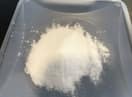
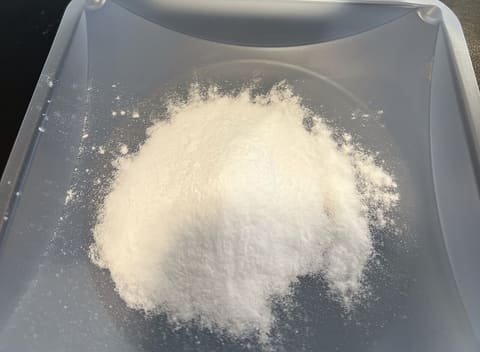
Anti-caking agents keep powders flowing: salt that pours in damp weather, spice mixes that do not set into a block, powdered drinks that stay loose. The ones on this page are all minerals or simple inorganic salts, and they are Halal.[4][6]
What is in the group
| Code | Name | Typical use |
|---|---|---|
| E551 | Silicon dioxide (silica) | Spices, powdered soups, drink powders, supplements |
| E552 | Calcium silicate | Salt, baking powder, icing sugar |
| E553a, E553b | Magnesium silicate, talc | Rice polishing, sweets, chewing gum dusting |
| E535, E536, E538 | Sodium, potassium and calcium ferrocyanide | Table salt, in very small amounts |
| E541 | Sodium aluminium phosphate | Leavening acid in some baking powders |
Silicon dioxide is the same compound as quartz and sand, refined to a fine powder. EFSA has reviewed its use as a food additive,[2] and certifier lists name it specifically as Halal.[3] Ferrocyanides sound alarming but are stable salts that do not release cyanide at the levels used; they are what keeps many table salts free-flowing. Talc in food is a purified mineral, not a cosmetic powder.
Health questions are separate
Debates about nano-sized silica or aluminium-containing additives are about safety and permitted levels. They are for regulators and personal choice, and they do not change the Halal ruling.[7]
The one anti-caking agent that is not a mineral
Edible bone phosphate (E542) does the same job but is made from animal bones, so its answer depends on the animal and its slaughter. It is uncommon in food today, but it is the one to watch for; see E542. Calcium phosphates can in principle also come from bone, though food-grade ones are usually mineral.
Where it leaves the food
An anti-caking agent in a seasoning tells you nothing about the rest of the powder. A soup or crisp seasoning may still contain meat powder, cheese or flavourings. For the salt itself, see salt, and for the raising agent often found beside these, sodium bicarbonate (E500).
How to verify
- Match E551–E555, E535–E538, E541, silica, or talc.
- Halal.
- E542 bone phosphate is a different page.
Quick checks
- Silica, silicates, talc and ferrocyanides are minerals: Halal in any product.
- E542 (edible bone phosphate) is the one anti-caking agent from animals; it has its own page.
- In a supplement or seasoning, the silica is fine; check the capsule shell and the other ingredients.
Frequently asked questions
Is silicon dioxide Halal?
What is INS 551 on a food label?
Is ferrocyanide in table salt Halal?
Is talc in food Halal?
Is every anti-caking agent mineral?
Scholarly view
Food talc is a mineral silicate, not an animal glaze. Bone phosphate is the animal anti-caking cousin.
Sources
Named Islamic, certifier, manufacturer, and regulatory sources used on this page. Inline markers like [1] jump here. Retrieval dates show when we last checked the live URL. Editorial methodology.
Certifier / jurisdiction
-
SANHA — E551 (Silicon dioxide)
SANHA Retrieved
Named SANHA E-number entry (ingredient-class; not a product certificate).
-
Regulatory / labelling
-
Food Safety and Standards (Labelling and Display) Regulations, 2020 — regulation 5(5)
Food Safety and Standards Authority of India (FSSAI) Retrieved
Declaration regarding food additives: functional classes shall be declared together with the specific name(s) or recognized International Numbering System (INS) in the list of ingredients.
-
EFSA — Re-evaluation of silicon dioxide (E551)
European Food Safety Authority Retrieved
Substance identity—not a Halal certificate for a finished pack.
-
Regulation (EC) No 1333/2008 on food additives
European Union Retrieved
Union-list identity—not a Halal certificate.
-
-
-
U.S. Food and Drug Administration Retrieved
US identity / labelling context—not a Halal ruling.
People also check
Related ingredients and products for this item.