
Additive identity
Possible source pathways
The finished molecule can be identical across feedstocks. The Halal ruling follows the pathway, not the code alone.
E574 Possible source pathways
- microbial Halal Typical Fermentation of plant carbohydrates or a defined microbial metabolite.
- plant Halal Typical The feedstock is plant.
What decides the answer
-
E574–E579
Halal fermentation salts -
Cheese may still list animal rennet beside GDL
Where you'll find it
- Tofu and bakery acids
- Black olive colour (ferrous gluconate)
Why this ruling
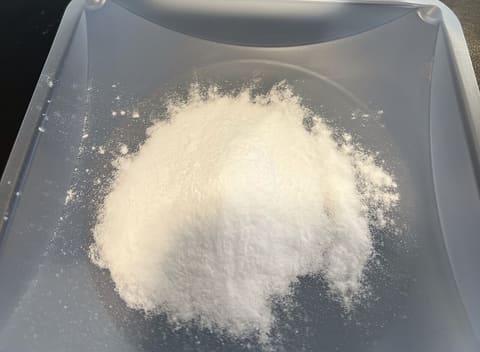
Gluconic acid (E574) and glucono-delta-lactone (E575), usually shortened to GDL, are made by fermenting glucose with a mould or bacteria. Their salts are sodium, potassium and calcium gluconate (E576–E578) and ferrous gluconate (E579). No animal is involved at any stage, and all of them are Halal.[2][4] US rules list GDL as a generally recognised food substance,[1] and certifier lists put the group with the additives that need no check.[5]
Why GDL is useful: a slow acid
GDL itself is barely sour. In water it slowly turns into gluconic acid over an hour or so, so it lowers the acidity of a food gradually and evenly instead of all at once. That makes it useful where a sudden acid would curdle or spoil the texture:
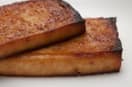
- Silken tofu – GDL sets soy milk into a smooth, custard-like block. It is the usual coagulant for silken and "soft" tofu, alongside calcium sulphate for firmer kinds. See tofu.
- Fermented sausages – it gives salami-type sausages their tang quickly and safely. The meat, not the GDL, decides those; see salami.
- Baking powder – a slow-acting leavening acid for cakes and doughs.
- Some fresh cheeses – as an acid set, in place of or alongside a starter culture.
The gluconate salts
- Calcium gluconate (E578) firms fruit and adds calcium to fortified foods.
- Ferrous gluconate (E579) fixes the black colour of ripe-style black olives.
- Sodium and potassium gluconate act as acidity regulators and salt substitutes.
A Halal way to set curds
Because GDL sets proteins without any enzyme, it is one of the ways fresh cheese and tofu can be made with no rennet question at all. A cheese that lists GDL may still list rennet as well, so read the whole label; see cheese. For the other fermentation acid used in the same foods, see lactic acid (E270).
How to verify
- Match E574–E579, GDL, or gluconate.
- Halal.
- Olives and tofu still need a full ingredient read.
Quick checks
- Gluconic acid, GDL and the gluconate salts are made by fermenting glucose: Halal.
- GDL sets silken tofu by acidity; it is not rennet.
- Ferrous gluconate (E579) keeps black olives black.
Frequently asked questions
Is GDL from milk?
Is ferrous gluconate in olives Halal?
Is GDL used in meat?
What is GDL in tofu?
Scholarly view
GDL is a slow acid, not a slaughter enzyme. It is a Halal coagulant option.
Sources
Named Islamic, certifier, manufacturer, and regulatory sources used on this page. Inline markers like [1] jump here. Retrieval dates show when we last checked the live URL. Editorial methodology.
Certifier / jurisdiction
Regulatory / labelling
-
21 CFR § 184.1685 glucono-delta-lactone
U.S. eCFR Retrieved
U.S. identity / GRAS or colour-additive listing—not a Halal ruling.
-
Regulation (EC) No 1333/2008 on food additives
European Union Retrieved
Union-list identity—not a Halal certificate.
-
-
-
U.S. Food and Drug Administration Retrieved
US identity / labelling context—not a Halal ruling.
People also check
Related ingredients and products for this item.