How to verify
- Confirm the meat is lamb or goat.
- Ask whether it is from Halal slaughter; local Cretan meat usually is not.
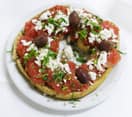
- Sides such as potatoes, salads and dakos are plant-based; check the cheese.
- Decline the tsikoudia and wine.
Quick checks
- Ask whether the lamb or goat is Halal-slaughtered; local Cretan meat usually is not.
- Only salt is added, so slaughter is the one question.
- At home, use Halal lamb or goat, coarse salt and a long, slow roast.
What decides the answer
-
Halal-slaughtered lamb or goat
Halal -
Taverna or festival antikristo from local meat
Halal if verified -
Tsikoudia and wine served alongside
Haram
Why this ruling
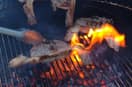
Antikristo is Crete's festival roast. Large pieces of lamb or goat, seasoned with nothing but coarse salt, are threaded onto long wooden or metal skewers, and the skewers are planted in the ground in a circle facing an open fire, which is what the name means: "opposite the fire". The meat is never over the flames; it cooks slowly in the heat for three to six hours, turned and moved by hand, until the fat has dripped away and the outside is crisp. It is the dish of weddings, baptisms and village festivals in the mountains of central Crete, and some tavernas cook it on Sundays.[3][1]
What decides it
| Part | Usually | Halal? |
|---|---|---|
| Meat | Lamb or goat, from local flocks | Only from Halal slaughter |
| Seasoning | Coarse salt, sometimes lemon | Yes |
| Sides | Potatoes, salads, bread, cheese | Usually yes; check the cheese |
| Drink served with it | Tsikoudia, wine | No |
The animal is one that can be Halal, and nothing is added to the meat but salt, so the only question is slaughter.[2] Cretan lamb and goat come from local flocks and local slaughterhouses; they are not slaughtered Islamically unless the taverna has arranged it, and on Crete that is rare. So an antikristo from a village festival or a taverna is not Halal by default.
What to do in Crete
If Halal meat matters to you, ask the taverna directly whether the lamb is from Halal slaughter, and expect the answer to be no. The sides are easier: potatoes, Cretan salads and dakos are plant-based, and the cheese depends on its rennet. Festivals pour tsikoudia and wine freely; soft drinks are always available.
At home
The method works with any Halal lamb or goat: large bone-in pieces, coarse salt, and a long, slow roast beside the heat rather than over it. A barbecue with the coals pushed to one side, or a very low oven, gives something close. For the meat, see lamb and goat; for the island, the Crete guide.
Frequently asked questions
Is antikristo Halal?
What does antikristo mean?
Can I make antikristo at home?
Scholarly view
Lamb and goat need Islamic slaughter; salt and fire change nothing. Tsikoudia and wine served with it are Haram.
Sources
Named Islamic, certifier, manufacturer, and regulatory sources used on this page. Inline markers like [1] jump here. Retrieval dates show when we last checked the live URL. Editorial methodology.
Islamic / scriptural
Context / background
-
Antikristo Is Crete's Fiery Feast (19 September 2025)
Argophilia Retrieved
Culinary identity: young lamb in large pieces, salted only, set in a circle facing an open fire for three to six hours. Identity context, not a Halal certificate.
-