
How to verify
- Read the full ingredient list for gelatin, gelatin hydrolysate, confectioner's glaze, shellac, or beeswax.
- Prefer bags with a recognized Halal mark when available.
- Do not trust unlabeled bulk bins or mixed candy bowls.
- Treat each brand (and each seasonal product) as a separate product.
- If gelatin or shellac conflict with your standard, choose certified Halal candy or pectin/agar sweets instead.
What decides the answer
-
Gelatin listed
follow gelatin/species rules; often Halal if verified or Haram if porcine/unclear -
Confectioner's glaze / shellac
many scholars permit; some consumers avoid—know your standard -
Halal-certified candy corn or alternative Halloween candy
Halal for that product -
Unlabeled bulk or mixed bowls
do not assume
Why this ruling
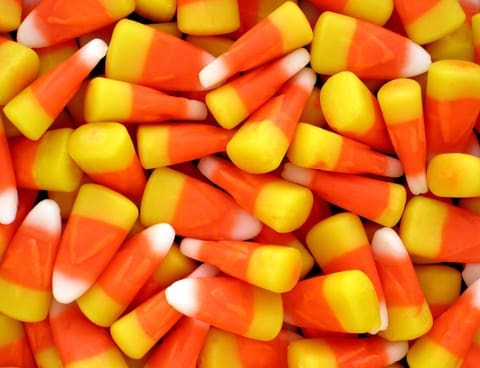
Candy corn is the tri-colour, corn-kernel-shaped sugar candy of American autumn and Halloween. The look is iconic; the recipe is not standardized. That is why Halal status is Halal if verified until the bag in your hand is checked.
Typical composition—and where risk sits
Classic candy corn is built from sugar, corn syrup, fondant, and flavourings (often honey/vanilla notes), pressed into yellow–orange–white layers. Binders and finishes are the Halal checkpoints:
| Additive | Why it matters |
|---|---|
| Gelatin | Animal collagen; species and slaughter must be acceptable |
| Confectioner's glaze / shellac | Insect-resin polish; accepted by many, avoided by some |
| Artificial colours | Usually synthetic; rarely the primary Halal issue |
| Natural flavors | Occasionally unclear carriers—read if listed vaguely |
Major U.S. makers such as Jelly Belly (historically Goelitz) publish product ingredient information on their sites (jellybelly.com, retrieved 20 July 2026). Use those lists as a starting map, then confirm the exact lot you bought—seasonal contract manufacturing can change.
The U.S. FDA's food-additive regulations and labelling rules require ingredients to appear on packaged candy (fda.gov, retrieved 20 July 2026). That transparency is your friend: if gelatin is present, it should be named. If the pack is unlabeled (bulk bin), you have lost that protection.
Brand and market nuance
Candy corn is primarily a North American seasonal product. Muslim-majority markets rarely treat it as a staple, so Halal-certified candy-corn products are uncommon compared with everyday chocolates. Some speciality Halal candy brands sell Halloween-style alternatives—those marks apply only to that brand's certified product, not to generic orange-white kernels in a supermarket value bag.
Do not transfer rulings from gummy bears or jelly beans by shape alone. Different factories, different gels.
Why it needs checking
Halal if verified means: the candy category mixes gelatin-free and gelatin-containing formulas, glaze practices vary, and certification is scarce. This site refuses a blanket Halal stamp for "candy corn" as a class. Consumers who need certainty buy certified sweets or brands whose current label clearly omits gelatin (and shellac, if they avoid it).
Realistic verification
- Buy sealed branded bags only.
- Read gelatin / glaze lines before pouring into a shared bowl.
- Prefer Halal-marked alternatives for parties serving Muslim guests.
- Re-check next Halloween—formulas and private-label suppliers change.
- When cooking with candy corn, the candy's ruling transfers into the dessert.
Halloween bowls and kids’ parties
Office and school bowls are the highest-risk setting: mixed brands, no wrappers, and scoops that also serve gelatin gummies. If you are hosting Muslim guests, put sealed Halal-checked candy in a separate bowl with the ingredient list still attached, or skip candy corn entirely in favor of verified chocolate. Private-label supermarket “autumn mix” bags often combine candy corn with other shapes that use different binders—treat the mix as its riskiest component. When baking candy-corn blondies or popcorn mixes, the ruling of the candy you poured in becomes the ruling of the dessert for guests who ask.
Where you'll find it
- Halloween treat bags and bowls
- Autumn decorative candy
- Baking and trail-mix mix-ins
- Seasonal bulk bins
Frequently asked questions
Does all candy corn contain gelatin?
Is confectioner's glaze Halal?
Why is this page Halal if verified instead of Halal?
Are bulk candy-store bins safe to assume?
Scholarly view
Candy corn is not a single recipe. The corn-kernel shape is marketing; the Halal questions are binder proteins and surface glaze. Gelatin (if present) is animal collagen and needs species/slaughter clarity. Shellac is an insect secretion used as confectioner's glaze—widely discussed; some consumers accept it, others avoid. Without certification, U.S. seasonal bags remain a label-by-label check.
Sources
Named Islamic, certifier, manufacturer, and regulatory sources used on this page. Inline markers like [1] jump here. Retrieval dates show when we last checked the live URL. Editorial methodology.
Regulatory / labelling
-
Retrieved
People also check
Related ingredients and products for this item.
Browse this topic
Open the parent category hub for more foods in the same group.