Additive identity
Possible source pathways
The finished molecule can be identical across feedstocks. The Halal ruling follows the pathway, not the code alone.
E442 Possible source pathways
- plant Halal Typical Usual food grade is vegetable oil, plant glycerol, or plant lecithin.
- animal Halal if verified The same chemistry can be split from tallow or animal glycerol. Pork or non-zabiha fat is haram.
- undisclosed Halal if verified Typical Labels rarely name the fat. Treat as mashbooh until a plant, vegan, or Halal claim settles it.
How to verify
- Match E442, ammonium phosphatides, or YN.
- Accept plant-oil, vegan, or Halal-certified chocolate.
- Email the maker if the pack is silent.
Quick checks
- A vegetarian, vegan or Halal mark on the chocolate settles E442.
- Without one, ask the maker which oil the phosphatides come from; rapeseed is typical.
- The same bar can hold other checks: whey, flavourings and fillings made with gelatin.
What decides the answer
-
Plant-oil / rapeseed YN, or Halal-certified chocolate
Halal -
Animal phosphatides — (zabiha) or haram if pork/non-zabiha
Halal if verified -
Unspecified E442
Halal if verified
Why this ruling
Ammonium phosphatides (E442), sold to manufacturers as emulsifier YN, are used almost only in chocolate. They are Halal if verified: typical food-grade YN is made from rapeseed oil, but the same chemistry can start from animal fat, and a bare "E442" does not say which.[2][1]
What it does in chocolate
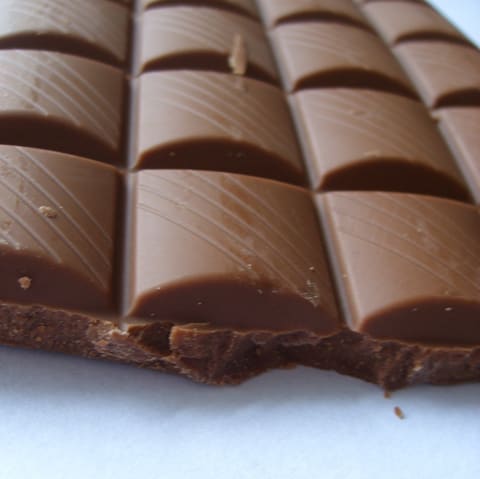
Chocolate is a suspension of sugar and cocoa particles in cocoa butter. An emulsifier coats those particles so the melted chocolate flows smoothly and needs less expensive cocoa butter. Soy or sunflower lecithin is the usual choice; YN does the same job with a more neutral flavour and a stronger effect on flow, which is why some confectioners prefer it. Several British milk chocolates list "emulsifiers (E442, E476)", pairing YN with PGPR (E476).
How it is made
A fat, usually partially hardened rapeseed oil, is reacted with glycerol, then with phosphorus pentoxide, and the result is neutralised with ammonia. The ammonia is an industrial chemical, not an animal product. The Halal question is only the starting fat: rapeseed or another plant oil gives a Halal emulsifier, while pork fat or fat from animals not slaughtered Islamically would not.[4]
How to settle it
Certifier E-number lists put source-dependent emulsifiers like this among the codes to check.[5] Any of these settles a bar:
- a Halal certificate on the chocolate;
- a vegetarian or vegan claim, which rules out animal fat;
- a manufacturer statement that the YN is rapeseed-based.
Without one of those, the bar stays Halal if verified. For the chocolate itself, see chocolate.
Where you'll find it
- Chocolate and cocoa compounds
Frequently asked questions
Is E442 Halal?
Is YN the same as lecithin?
Why do chocolate makers use E442?
How do I check E442?
Scholarly view
This follows the same source-dependent reading as lecithin and E471. Rapeseed YN is Halal after identity is known. Unlabeled lots stay Halal if verified.
Sources
Named Islamic, certifier, manufacturer, and regulatory sources used on this page. Inline markers like [1] jump here. Retrieval dates show when we last checked the live URL. Editorial methodology.
Certifier / jurisdiction
Regulatory / labelling
-
EFSA — Re-evaluation of ammonium phosphatides (E442)
European Food Safety Authority Retrieved
Substance identity—not a Halal certificate for a finished pack.
-
Regulation (EC) No 1333/2008 on food additives
European Union Retrieved
Union-list identity—not a Halal certificate.
-
-
-
U.S. Food and Drug Administration Retrieved
US identity / labelling context—not a Halal ruling.
People also check
Related ingredients and products for this item.