
Additive identity
Possible source pathways
The finished molecule can be identical across feedstocks. The Halal ruling follows the pathway, not the code alone.
E473 Possible source pathways
- plant Halal Typical Fatty acids from palm, soy, sunflower, coconut, or other vegetable oils.
- animal Halal if verified The same esters can be split from tallow or lard. Pork or non-zabiha fat is haram; audited zabiha tallow is accepted after audit.
- undisclosed Halal if verified Typical Most labels print only the E-number or US chemical name. Treat as mashbooh until a plant, vegan, or Halal claim settles the fat.
How to verify
- Match E473, E474, INS 473/474, sucrose esters, or sucroglycerides.
- They share E471’s fat-source logic.
- Vegetarian chocolate or Halal marks settle most retail packs.
Quick checks
- E473 is sugar bonded to fatty acids; the fatty acids can be plant or animal.
- E474 (sucroglycerides) carries the same question.
- A vegetarian, vegan or Halal mark settles it; without one it is Halal if verified.
What decides the answer
-
Plant-fat E473/E474, or vegetarian/vegan claim
Halal -
Halal-certified chocolate
Halal -
Pork or non-zabiha fatty acids
haram -
Unspecified sucrose esters / E473 / E474
Halal if verified
Why this ruling
Sucrose esters of fatty acids (E473) are made by joining ordinary sugar to fatty acids. Sucroglycerides (E474) are a related mixture of sucrose esters with mono- and diglycerides. Both are emulsifiers, used to keep fat and water together.[1][4]
Where the question is
Sugar is Halal. The fatty acids are the part that can come from a plant or an animal, and in E474 so can the glyceride part.[2] The ruling follows that source:
- Fatty acids from vegetable oil → Halal.
- From the fat of a Halal-slaughtered animal → Halal.
- From pork fat or non-Halal slaughter → not Halal.
- Not stated → Halal if verified.
Certifier lists put unsourced E473 in the doubtful group for the same reason as E471.[5] Being made with sugar does not settle it.
Where you will find it
Sucrose esters work at low levels and in a wide range of textures, so they turn up in:
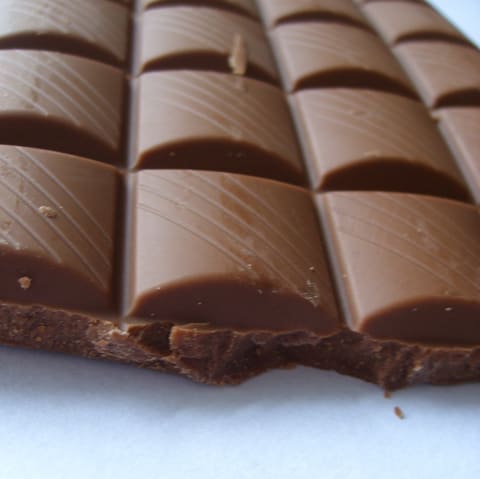
- chocolate and chocolate coatings, often next to lecithin or PGPR (E476),
- ice cream and whipped toppings,
- coffee whiteners and ready-to-drink coffee,
- baked goods and fillings,
- coatings on fresh fruit, in some markets.
Their Japanese and US names are often sugar esters or sucrose fatty acid esters. EU packs print the code.
Settling it
A vegan claim settles E473 and E474 along with the other emulsifiers on the pack, and so does a Halal certification. Many producers make sucrose esters from palm or other vegetable fatty acids; the brand can confirm which. For chocolate in general, see chocolate.
Frequently asked questions
Is E473 the same as sugar?
What is E474?
Where is E473 used?
How do I check E473?
Scholarly view
Sucrose does not change the fat ruling. Unspecified E473 is mashbooh like unlabeled E471. No ruling makes sugar esters automatically Halal.
Sources
Named Islamic, certifier, manufacturer, and regulatory sources used on this page. Inline markers like [1] jump here. Retrieval dates show when we last checked the live URL. Editorial methodology.
Certifier / jurisdiction
-
SANHA Retrieved
Source-dependent additives listed mashbooh pending origin.
Regulatory / labelling
-
Regulation (EC) No 1333/2008 on food additives
European Union Retrieved
Union-list identity—not a Halal certificate.
-
EFSA — Sucrose esters of fatty acids (E473) and sucroglycerides (E474)
European Food Safety Authority Retrieved
Sucrose plus fatty acids that may be vegetable or animal.
-
-
People also check
Related ingredients and products for this item.