
Is E901 (Beeswax) Halal?
Yes — this one is Halal.
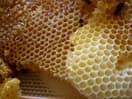
Beeswax (E901, INS 901) is a purified secretion of the honey bee used as a glaze and carrier.
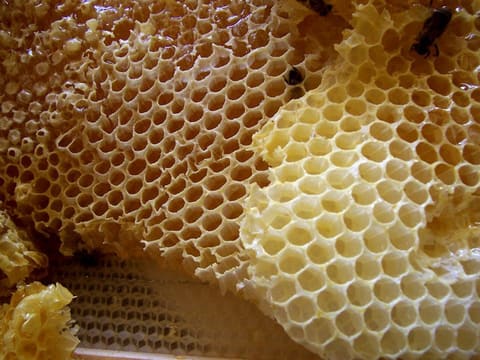
Photo: Merdal at Turkish Wikipedia · CC BY-SA 3.0
Additive identity
Possible source pathways
The finished molecule can be identical across feedstocks. The Halal ruling follows the pathway, not the code alone.
E901 Possible source pathways
- insect Halal Typical Beeswax is a secretion of the honey bee, analogous to honey: not pork, not carrion flesh, not an intoxicant as eaten. Mainstream Halal practice treats food-grade beeswax as Halal.
What decides the answer
-
Food-grade beeswax / E901 as glaze
Halal on this site -
Personal insect-avoidance
choose carnauba (E903) or unwaxed sweets -
Finished confectionery still needs gelatin, carmine, and flavour checks
Why this ruling
Beeswax (E901, INS 901) is the wax that worker bees secrete to build their honeycomb. When honey is harvested, the cappings and old comb are melted, filtered and sold as yellow wax, or bleached to white. Food makers use it as a glazing agent: the thin coat that stops sweets sticking and gives them a shine. On this site it is Halal.[4][7]
Why it is Halal
Beeswax is something bees make, the way they make honey. It is not a ground-up insect and it is not a dye pressed from insects. Mainstream practice treats it like honey, and certifier E-number lists put E901 with the permitted glazing agents.[8] EU rules set out where it may be used and in what amounts.[5]
Where you will find it
- Gummy sweets – many list "beeswax white and yellow" as the anti-stick coat.
- Jelly beans and sugar-shelled sweets – usually with carnauba wax and confectioner's glaze.
- Chocolate-coated and panned sweets, dried fruit and some chewing gum.
- Some fresh fruit, where a surface coat is allowed.
- Flavour and colour carriers, in small amounts.
Three coatings that get confused
Glazed sweets often list more than one coating, and each has its own ruling:
| Coating | What it is | Ruling on this site |
|---|---|---|
| Beeswax (E901) | Bee secretion, like honey | Halal |
| Carnauba wax (E903) | Leaf wax of a Brazilian palm | Halal |
| Shellac (E904), "confectioner's glaze" | Resin secreted by the lac insect | Halal; see shellac |
Carmine (E120) is not a coating but a red colour made from crushed cochineal insects, and it has a real scholarly difference; see carmine. Beeswax does not share that question.
If you avoid anything from insects
Some people avoid all insect-linked ingredients as a personal choice. That is a preference rather than the ruling here. For them, carnauba wax, E903, is the plant alternative, and unglazed sweets avoid the question.
The sweet is more than its glaze
A Halal glaze does not make the sweet Halal. Gummies usually depend on their gelatin, and chocolate on its emulsifiers and flavourings; see jelly beans and chocolate. For honey itself, see honey.
How to verify
- Match beeswax, white wax, yellow wax, E901, or INS 901.
- Treat standard food beeswax as Halal.
- If you personally avoid all insect products, choose carnauba (E903) instead.
- Still vet gelatin, carmine, and alcohol flavourings on glazed sweets.
Quick checks
- E901 = beeswax = bee secretion → Halal here.
- Not carmine; not gelatin.
- Still read the rest of the sweet.
Frequently asked questions
Is beeswax Halal?
Is E901 the same as E904?
Is it Halal to eat honeycomb?
Is lip balm or lipstick with beeswax Halal?
Is beeswax vegan?
Scholarly view
Beeswax is a secretion, not minced insect. That is why it tracks honey rather than the carmine (E120) insect-dye debate. SANHA and similar lists treat E901 as Halal. A minority of consumers avoid all insect-linked inputs; carnauba wax (E903) is the plant alternative. Do not conflate beeswax with shellac (E904, lac insect) or carmine.
Sources
Named Islamic, certifier, manufacturer, and regulatory sources used on this page. Inline markers like [1] jump here. Retrieval dates show when we last checked the live URL. Editorial methodology.
Islamic / scriptural
-
Food Guide (GMWA), checked by Mufti Abdullah Retrieved
2003, authorised by Mufti Abdullah: beeswax is Halaal; it is the wax secreted by honeybees to build the honeycomb, salvaged after the honey is extracted.
-
Is beeswax permissible in lipstick?
Darul Ifta Birmingham, Mufti Mohammed Tosir Miah (via IslamQA.org) Retrieved
Beeswax is halal (citing the Food Guide); therefore lipsticks that contain beeswax are permissible.
-
Qur'an Retrieved
From the bees' bellies comes a drink of varying colours, in which there is healing for people.
Certifier / jurisdiction
-
SANHA — E-numbers (beeswax / related glazing agents)
SANHA Retrieved
Certifier E-number literacy; beeswax treated as a bee product, not pork.
Regulatory / labelling
-
Regulation (EC) No 1333/2008 on food additives
European Union Retrieved
Union-list identity for E901 beeswax.
-
EFSA — Beeswax (E901) as a food additive
European Food Safety Authority Retrieved
Identity as beeswax (white and yellow). Safety opinion, not Halal.
-
-
People also check
Related ingredients and products for this item.