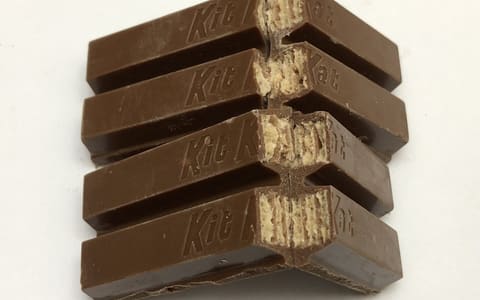
KitKat is a chocolate-covered wafer bar—layers of crisp wafer coated in milk chocolate, broken into fingers. Outside the United States it is a Nestlé product; inside the U.S. it is produced under license by The Hershey Company. That split ownership is the first reason Halal answers cannot be copied from one country's Instagram photo to another supermarket aisle.
What is usually on the classic bar
On classic U.S. Hershey milk-chocolate KitKat pages the emulsifiers are soy lecithin and PGPR, with palm oil / palm kernel oil in the vegetable-oil line—not E471. Hershey’s Kit Kat product hub and milk-chocolate 1.5 oz 6-pack page are the binding US references (hersheyland.com/kit-kat; 1.5 oz 6-pack, retrieved 12 August 2026). Companion classic milk XL/King Size ingredient panels on Hersheyland likewise list lecithin (soy) and PGPR without mono- and diglycerides. So E471 is not a concern for the classic US bar; other KitKat products need their own label check.
Nestlé-market formulas (UK and elsewhere) can differ—read that wrapper. That profile is why large numbers of Muslims eat standard KitKat when no Halal mark is available. It is also why KitKat is not treated as Haram.
The remaining gaps are real:
- Emulsifiers on classic US Hershey bars are soy lecithin + PGPR (plant-route PGPR is usual industrial practice, but Halal still follows the sealed pack / certifier). E471 belongs only to products that list it.
- Dairy and flavour processing standards differ by plant and licensee.
- Speciality products—matcha, sake-inspired, liquor-named, filled, or white-chocolate variants—are not the classic four-finger milk bar.
Certification differs by country
Nestlé operates regional supply chains. In Muslim-majority markets, Nestlé confectionery is frequently sold under national Halal certification. In Malaysia, the authoritative public check is JAKIM's Portal Halal Malaysia (MYeHALAL): https://myehalal.halal.gov.my/portal-halal/v1/index.php?lang=bm (retrieved 20 July 2026). Search the company/product details that match the wrapper and confirm the certificate is active. JAKIM's parent department site is islam.gov.my (retrieved 20 July 2026). Nestlé Malaysia also publishes consumer-facing Halal information for its local portfolio (nestle.com.my, retrieved 20 July 2026)—still confirm against the sealed pack and JAKIM directory, not marketing copy alone.
In the United States, everyday supermarket KitKat typically does not carry IFANCA, HFA, HMC, or JAKIM marks, and the producer is Hershey, not Nestlé. A bar photographed in Kuala Lumpur does not certify a bar bought in Chicago.
Indonesia, the Gulf, and other certified Nestlé markets likewise use local Halal marks on locally distributed lines—again, pack-level evidence only.
Why status is Market-dependent
This site's Market-dependent label means: ingredients often look acceptable, but certification, licensee, and minor additives are not uniform. Consumers who require a certifier logo should buy certified market packs or another certified candy. Consumers who accept clear labels without gelatin still re-check each purchase because formulas and limited editions drift.
Realistic verification
- Country and producer first (Nestlé vs Hershey).
- Wrapper ingredients second.
- Printed Halal mark third.
- Official directory (e.g. JAKIM portal in Malaysia) when you want proof beyond marketing claims.
- Reset assumptions for limited editions, airport duty-free wrappers, and ice-cream or dessert KitKat variants.
Airport duty-free and import shops add another wrinkle: the wrapper language may not match the country you are standing in. Trust the printed Halal mark and ingredient list on that sealed bar, not the store's location.