
What decides the answer
-
Plain tea (black, green, oolong, white) brewed with water
Halal -
Chai and milk tea: the tea is Halal; check any creamer or syrup like any other product
-
Bubble tea: check jellies (gelatin), pink colours (carmine) and syrup flavourings
-
Bottled and flavoured teas: read the label
-
Kombucha and alcoholic tea drinks: separate pages and rulings
Where you'll find it
- Black, green, oolong, and white tea
- Chai with milk and spices
- Matcha lattes and Japanese tea
- Iced and bottled teas
- Bubble tea bases
Why this ruling
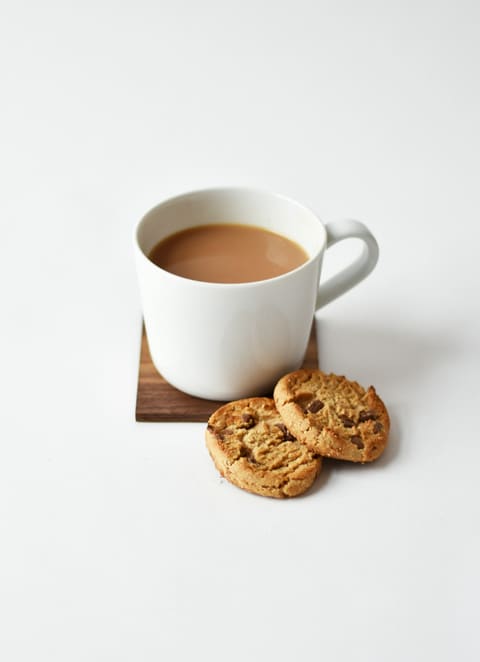
Tea, from Moroccan mint to Kashmiri chai, is Halal in its plain form: leaves steeped in hot water. Black, green, oolong, white and pure matcha powder are the same kind of leaf at different stages of processing.
What the rulings say
- Shafi'i (Qibla, Shaykh Amjad Rasheed): a pure substance is unlawful only if it causes harm most of the time. Tea's harm is rare, so it is not unlawful. If a doctor tells someone that tea will harm them specifically, it becomes unlawful for that person.[1]
- Hanafi (MuftiOnline): a tea with no impure or impermissible ingredients is permissible; if an ingredient is doubtful, refrain.[2]
- Hanafi (Jamia Binoria): tea in a restaurant that also serves Haram food is allowed, provided no Haram ingredient is mixed in and it is prepared in clean utensils.[3]
So plain tea is straightforward, and the rulings put the question where it belongs: on what is added to the cup and how it is prepared. For caffeine as a health matter, the FDA's consumer guidance on intake is background, not a ruling.[4]
Flavoured, bottled and café teas are separate checks
-
Flavoured blends (Earl Grey's bergamot, fruit teas) may use flavourings, some carried in alcohol. Labels rarely say. Scholars differ on flavouring carriers; see natural flavors and choose a certified or plainly labelled blend if you want certainty.
-
Bubble tea: tapioca pearls are made from cassava starch, but some jelly toppings are set with gelatin, popping boba and syrups carry flavourings, and a pink or red drink may be coloured with carmine. Ask what each topping contains.
Packaged versions show the range. Tapioca pearls list "tapioca starch, water, corn starch", a gum and preservatives, with nothing from an animal.[5] Popping boba is set in a skin of sodium alginate and calcium lactate, not gelatin; see alginates.[6] Milk teas made with a non-dairy creamer can list E471 of unstated source; one ready-made milk tea carries a Halal label as well.[7]
-
Bottled teas and instant chai: read the label for creamers, emulsifiers, colours and "natural flavors", as for any drink.
-
Café matcha drinks: pure matcha is plain tea; syrups and desserts made with it are separate products.
Kombucha and alcoholic tea drinks
Kombucha is tea deliberately fermented, and fermentation produces some alcohol. It has its own page with its own rulings: see Kombucha. Alcoholic "hard" teas sold in similar cans are a different product again. Don't carry the plain-tea answer over to either.
Realistic verification
- Plain loose-leaf or bagged tea: Halal.
- Chai and milk tea: the tea is Halal; check any creamer or syrup.
- Boba: confirm gelatin-free jellies and non-carmine colours.
- Bottled flavoured teas: read the label once.
- Kombucha and alcoholic tea drinks: their own pages.
How to verify
- Plain tea leaves and water need no check.
- For bottled teas, chai mixes and flavoured blends, read the label for alcohol-based flavourings or animal-derived additives.
- For boba, ask about the jellies and colours.
- Kombucha and alcoholic 'hard' teas have their own pages and rulings.
Frequently asked questions
Is plain tea halal?
Is matcha halal?
Is bubble tea halal?
Do flavoured teas contain alcohol?
Scholarly view
Plain tea is covered by named rulings: Shaykh Amjad Rasheed (Shafi'i) treats tea as permissible because its harm is rare, while noting that anything a doctor says will harm you specifically becomes unlawful for you; MuftiOnline (Hanafi) says a tea with no impure or impermissible ingredients is permissible.
What goes into the cup beyond leaves and water is a separate product question: flavourings, boba toppings, colours, kombucha fermentation and alcoholic tea drinks.
Sources
Named Islamic, certifier, manufacturer, and regulatory sources used on this page. Inline markers like [1] jump here. Retrieval dates show when we last checked the live URL. Editorial methodology.
Islamic / scriptural
-
Is it unlawful to consume sugar and tea?
Qibla, Shaykh Amjad Rasheed (via IslamQA.org) Retrieved
Shafi'i. A pure substance is unlawful only if it causes harm most of the time; tea's harm is rare, so it is not unlawful, though it becomes unlawful for someone a doctor says it will harm.
-
Can Muslims drink tea from companies that use Ayurvedic medicine?
MuftiOnline (via IslamQA.org) Retrieved
Hanafi. Mufti Zakaria Makada, checked by Mufti Ebrahim Salejee: "If there are no impure or impermissible ingredients used, then it is permissible. However if there are any doubtful ingredients used, then one should refrain."
-
Is it allowed to have tea in a restaurant that serves haram food also?
Jamia Binoria (via IslamQA.org) Retrieved
Hanafi. Tea in such a restaurant is allowed "provided no Haram ingredients are mixed in tea etc and prepared in clean and pure utensils".
Manufacturer / product
-
WuFuYuan tapioca pearls (6927055989316)
Open Food Facts (pack record) Retrieved
Ingredients: 'tapioca starch, water, corn starch, thickening agent: [e412], preservative: [e262ii, e202]', then colours. Nothing animal-derived.
-
O's Bubble jelly popping boba drink (0850021166137)
Open Food Facts (pack record) Retrieved
Ingredients include 'Popping Boba (Water, Fructose, Calcium Lactate, Sodium Alginate', then xanthan gum, malic acid and flavourings. The skin is alginate, not gelatin.
-
Lady Boba milk tea (4711115020017)
Open Food Facts (pack record) Retrieved
Ready-to-drink milk tea with starch balls; its non-dairy creamer lists 'Mono- and Diglycerides of Fatty Acids (Emulsifier)(E471)'. Halal label recorded.
Regulatory / labelling
-
Spilling the beans: how much caffeine is too much?
U.S. FDA Retrieved
Health background on caffeine intake. Not a religious ruling.
People also check
Related ingredients and products for this item.