
Scholarly differences
Classical disagreement centers on whether every sea creature is ‘fish’ in the fiqh sense. Quran 5:96’s permission of sea game is read broadly by many non-Hanafi jurists and more narrowly by many Hanafi authorities. Mussels sit with other mollusks under that split.
Readers should follow their school. Cooking with wine is a separate, clearer prohibition when the broth is wine-based.
What decides the answer
-
White-wine / beer steam broths
avoid regardless of madhhab on the animal -
Shafi‘i, Maliki, and Hanbali majority practice: mussels treated as permissible seafood
-
Many Hanafi positions: mussels not equivalent to fish—follow your school
-
School-agnostic strict approach: choose fish instead of disputed mollusks
How to verify
- Decide whether you follow a madhhab that permits mussels (common Shafi‘i/Maliki/Hanbali practice) or a restrictive Hanafi seafood view.
- Apply that ruling consistently to other mollusks your scholar groups with mussels.
- If you only eat unanimously accepted seafood, choose fish.
- Separately reject white-wine steaming liquids, pork fat, and non-Halal butter sauces.
Why this ruling
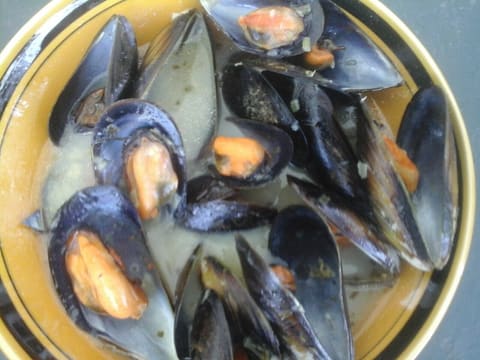
Mussels are bivalve mollusks—two-shell filter feeders sold live, frozen, or cooked in coastal cuisines worldwide. Blue mussels and related species appear in Belgian moules, Italian pasta, Spanish paella, and Southeast Asian curries. The Halal question that matters is rarely contamination with pork inside the shell—it is whether mollusks count like fish in the school you follow.
Why scholars differ
A large body of scholarship—especially among Shafi‘i, Maliki, and Hanbali jurists—permits mussels and similar sea creatures under broad seafood readings. Many Hanafi authorities draw a tighter line: fish are clear; mussels and other shellfish are not treated the same. Because sincere Muslims following different schools reach different practical answers, IsItHalal marks mussels Scholarly difference because scholarly rulings differ, aligned with shellfish and shrimp, rather than forcing a single global Halal label.
What is not the dispute. Mussels do not require land-animal zabiha. Alcohol is not inherent in mussel meat. Farmed vs wild is food-safety and sustainability, not the madhhab split. Imitation “seafood” sticks made from fish surimi follow fish rules plus additives.
Kitchen reality: wine broths
Even when your school permits mussels, restaurant prep often fails a different test. Classic moules marinières steam mussels in white wine, shallots, and butter. Beer broths appear in some pub menus. Those liquids are intoxicant-based cooking—avoid them. Ask for mussels steamed in tomato, coconut milk, garlic-butter without wine, or plain water/stock you trust. Bacon lardons and pork sausage in “fisherman” pots are separate Haram add-ins.
Food-safety guidance on buying and cooking live mussels is published by agencies such as FDA Food (retrieved 20 July 2026); that guidance is about vibrio and spoilage, not fiqh—but it explains why restaurants keep live tanks and wine-heavy recipes.
Consistency with other shellfish
If you eat mussels under a permissive scholarly view, apply the same view to oysters, clams, and similar mollusks unless your scholar draws finer lines. If you avoid mussels under a Hanafi-oriented rule, do not treat “mussel pasta” as a loophole while refusing oysters. Category pages help: start at shellfish.
Realistic verification
- Ask your madhhab teacher how they classify mussels.
- Apply that answer before you worry about brand of frozen mussels.
- If mussels are permitted for you, still veto wine/beer broths.
- If you want zero school disagreement, order fish.
- Ignore viral “all seafood is always Halal/Haram” posts that erase madhhab difference.
Where you'll find it
- Steamed mussels in broth (moules)
- Pasta, paella, and seafood stews
- Grilled or baked stuffed mussels
- Fritto misto and seafood platters
Frequently asked questions
Are mussels Halal?
Do mussels need zabihah slaughter?
Are moules-frites Halal if my school allows mussels?
Are mussels the same ruling as oysters?
What should I order for zero school disagreement?
Sources
Named Islamic, certifier, manufacturer, and regulatory sources used on this page. Inline markers like [1] jump here. Retrieval dates show when we last checked the live URL. Editorial methodology.
Islamic / scriptural
-
IslamWeb 87405 — crabs and school opinions
IslamWeb Retrieved
Names Hanafi / Maliki / Shafi‘i / Hanbali positions on crab (and analogous shellfish).
-
IslamWeb 81789 — sea creatures being Halal
IslamWeb Retrieved
Summarises four-Imam disagreement on non-fish sea animals.
Certifier / jurisdiction
-
JAKIM / Portal Halal Malaysia (MYeHALAL)
JAKIM Retrieved
Public Malaysian Halal directory for company/product checks; certificate scope is market-specific.
Regulatory / labelling
-
Retrieved