
Scholarly differences
Oysters follow bivalve rulings, sourced here by named desks rather than by Qur'an 5:96 alone. Mufti Ebrahim Desai (Albalagh) summarises the four Sunni schools on oysters specifically. SeekersGuidance (Shaykh Irshaad Sedick, citing Nawawi and Reliance) permits oysters in Shafi'i fiqh.
Darul Uloom Deoband rules oysters haram for Hanafis. Ayatollah Sistani: shellfish is not Halal; only scaled fish and shrimp among marine animals. FDA seafood guidance is hygiene, not a madhhab ruling.
What decides the answer
-
Shafi'i, Maliki, Hanbali (Albalagh; SeekersGuidance for Shafi'i): oysters Halal—raw or cooked, no slaughter needed
-
Hanafi (Albalagh; Darul Uloom Deoband): not permissible—oysters are not fish
-
Ja'fari (Sistani): shellfish not Halal—scaled fish and shrimp only
-
Preparation: champagne mignonette, beer batter, and bacon toppings are problems
-
Oyster sauce: Albalagh treats oyster extract as not Hanafi-permissible—see oyster-sauce page
How to verify
- Follow your madhhab or trusted local scholar on shellfish.
- If you avoid disputed seafood, choose scaled fish instead.
- If you eat oysters, still reject champagne mignonettes, beer batter, and bacon toppings.
- Treat oyster sauce as a separate condiment question—Albalagh treats oyster extract as not permissible for Hanafis; see the oyster-sauce page or choose mushroom 'oyster' sauce.
- Do not assume restaurant 'seafood tower' items share one ruling.
Why this ruling
Oysters—eaten raw on ice with lemon, grilled under butter, fried into po'boys, and reduced into the oyster sauce that anchors Cantonese cooking—are bivalve mollusks. In Islamic law they travel with their family: shellfish whose status splits along school lines. The rulings below are ones that name oysters or shellfish.
School split (named sources)
Qur'an 5:96 (“Lawful to you is the game of the sea”) is the verse the schools interpret (quran.com/5/96, retrieved 25 August 2026). It is not, by itself, a school-by-school oyster ruling.
Shafi'i, Maliki, Hanbali — permitted. Mufti Ebrahim Desai, citing Fiqh ala al-Madhahib al-Arba'ah, writes that Hanbali and Shafi'i scholars treat all living sea creatures as Halal whether or not they look like fish, so oyster (and oyster extract) is Halal; Maliki scholars permit every living sea creature except eel, so oysters are Halal there too (Albalagh / islamqa.org 22478, retrieved 25 August 2026). SeekersGuidance’s Shafi'i answer by Shaykh Irshaad Sedick, citing Nawawi’s Majmu' and Keller’s Reliance of the Traveller, permits oysters and mussels as aquatic game that need no slaughter (SeekersGuidance, retrieved 25 August 2026).
Hanafi — not permitted. The same Albalagh answer says Hanafis permit only sea creatures in the form of a fish (with hagfish and eel exceptions), so oysters, oyster extract, shrimp, and lobster are not permissible. Darul Ifta, Darul Uloom Deoband, answers that according to Hanafis it is haram to eat oyster and crab, and that among sea animals only fish is Halal in that fatwa (Deoband 78974, retrieved 25 August 2026).
Ja'fari — not permitted. Ayatollah Sistani’s office: it is not permissible to eat from marine animals anything except fish that has scale; shrimp is from that permitted category; shellfish is not Halal (sistani.org/english/qa/01184, retrieved 25 August 2026). Oysters are shellfish, not scaled fish.
Food-safety programs inspect seafood for hygiene (fda.gov, retrieved 20 July 2026). That is not a Halal fatwa. Oysters are bivalves, not cephalopods or tuna—do not copy those pages’ sources onto this animal.
Oyster sauce note
Oyster sauce reaches far more Muslim kitchens than the mollusk itself. For readers whose school permits oysters, the condiment is Halal when other ingredients are clean (see oyster sauce). For Hanafis, do not assume a processed-extract licence: Albalagh treats oyster extract as not permissible with oysters themselves. Mushroom-based “vegetarian oyster sauce” replicates the flavour without the bivalve.
Kitchen vigilance
For those who eat oysters, standard kitchen vigilance applies:
- Champagne mignonettes
- Beer-battered frying
- Bacon-topped baked oysters
- Anise-liqueur Rockefeller recipes
Ice, lemon, and a clean mignonette need no extra ruling. Compare related mollusks: clams, mussels, scallops.
Practical path
If your school permits oysters, order simply prepared shellfish and ask about alcohol and pork. If your school does not, choose scaled fish such as salmon or cod. A Halal mark on a packaged sauce certifies that product, not the raw bar.
Dining practice and packaged products
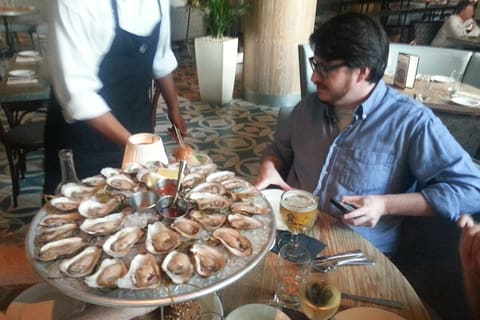
Raw bars often present oysters with champagne mignonette, cocktail sauce, or lemon only. Lemon-only is the simplest Halal-compatible dressing for diners whose school permits oysters; champagne-based sauces are not. Cooked oyster dishes in steakhouses may arrive topped with bacon jam or Pernod cream—ask before ordering Rockefeller-style plates.
Canned smoked oysters are typically oysters, oil, and salt; flavoured cans can add wine or non-Halal broth notes. Hot sauces and seafood boils sometimes mix oysters with sausage—another pork cross-check for those who eat the mollusk. Coastal tourist menus love oyster shooters with vodka; the shot is Haram regardless of your shellfish school. If your household mixes madhhabs, agree on a house rule (eat / avoid) rather than renegotiating each seafood tower. For Hanafi and Ja'fari households, mushroom oyster sauce matters more than raw bars.
Where you'll find it
- Raw oysters on the half shell
- Grilled and baked oysters (Rockefeller)
- Fried oyster po'boys
- Oyster sauce in Asian cooking
- Smoked canned oysters
Frequently asked questions
Are raw oysters Halal?
Is oyster sauce Halal for Hanafis if oysters are not?
What about oysters Rockefeller and po'boys?
Do pearls make oysters special in Islamic law?
Is food-safety inspection the same as Halal?
Sources
Named Islamic, certifier, manufacturer, and regulatory sources used on this page. Inline markers like [1] jump here. Retrieval dates show when we last checked the live URL. Editorial methodology.
Islamic / scriptural
-
Retrieved
The sea-game verse schools interpret. Not, by itself, a named school ruling on oysters.
-
Mufti Ebrahim Desai / Albalagh — sea food in the four madhhabs
Albalagh (via islamqa.org) Retrieved
Names oysters: Halal for Hanbali, Shafi'i, and Maliki (Maliki except eel); not permissible for Hanafis, including oyster extract.
-
SeekersGuidance — permissibility of oysters and mussels (Shafi'i)
SeekersGuidance Retrieved
Shaykh Irshaad Sedick: oysters and mussels are aquatic game; cites Nawawi’s Majmu' and Keller’s Reliance. Shafi'i lane only.
-
Darul Uloom Deoband — is oyster Halal or Haram?
Darul Ifta, Darul Uloom Deoband Retrieved
Hanafi: haram to eat oyster and crab; among sea animals only fish is Halal in this fatwa.
-
Ayatollah Sistani — fish / shellfish Q&A
Office of Ayatollah Sistani Retrieved
Marine animals: only scaled fish; shrimp is from that permitted category. Shellfish is not Halal. Oysters are shellfish, not scaled fish.
Regulatory / labelling
People also check
Related ingredients and products for this item.