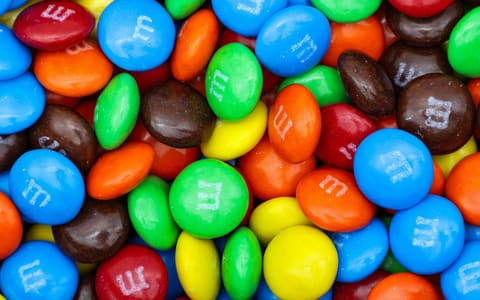
M&M's are the world's best-selling chocolate candy - button-sized milk chocolate in a hard sugar shell, from the plain and peanut originals to caramel, crispy, and endless seasonal editions. Their halal status is the sharpest example in the candy aisle of a rule every Muslim shopper eventually learns: the wrapper does not decide - the market does.
In Malaysia, Indonesia, and several Gulf markets, M&M's are produced under halal certification (JAKIM in Malaysia) and carry the logo on-pack: fully halal, question closed. In the UK, the brand's own answer is no: the official M&M's UK account said in 2019 that none of the M&M's, in any variety, are suitable for a Halal diet (M&M's UK on X, retrieved 5 October 2026), and UK peanut and crispy packs list carmine (E120) (Open Food Facts, retrieved 5 October 2026).
EU packs carry no Halal certification either; treat them as unverified. In the US, the picture is the murky middle: no certification exists, plain and peanut varieties list no overtly animal ingredients (no gelatin, no carmine on current labels), but the sourcing of colourings, glazes, and emulsifiers is undisclosed - textbook mashbooh (doubtful) territory that cautious eaters step around.
What drives the differences? Chocolate manufacturing leans on emulsifiers (E471-family ingredients that can be plant or animal derived), confectioner's glaze, and colourings - all cheap to source either way, all invisible on a Western label, and all locked down only when a certifier audits the chain. The certified Malaysian production shows nothing in M&M's requires haram inputs; the uncertified Western production just doesn't promise anything.
Practical playbook: packs from Muslim-majority markets with a halal logo are fine and travel well (halal M&M's are a known import item at Muslim grocers). UK packs: the maker says no, so choose a certified alternative. EU packs: treat as unverified. US packs: your call on doubtful items, with certified halal chocolate gems from specialist brands available for those who prefer the clean answer. And check seasonal novelties separately - reformulations and speciality coatings are where surprises live.
Variant table (checked 5 October 2026)
United States
| Variant |
On the pack |
Reading |
| Milk Chocolate |
No gelatin or carmine; synthetic colours |
Not certified; no animal ingredients listed[2] |
| Peanut |
No gelatin or carmine; synthetic colours |
Not certified; no animal ingredients listed[3] |
| Peanut Butter |
No gelatin or carmine; synthetic colours |
Not certified; no animal ingredients listed[4] |
| Caramel |
No gelatin or carmine; synthetic colours |
Not certified; no animal ingredients listed[5] |
| Crispy |
No gelatin or carmine; synthetic colours |
Not certified; no animal ingredients listed[6] |
| Almond |
No gelatin or carmine; synthetic colours |
Not certified; no animal ingredients listed[7] |
| Pretzel |
No gelatin or carmine; synthetic colours |
Not certified; no animal ingredients listed[8] |
United Kingdom
| Variant |
On the pack |
Reading |
| Peanut |
Carmine (E120) |
Haram: the maker says no UK variety is Halal-suitable[9] |
| Crispy |
Carmine |
Haram: the maker says no UK variety is Halal-suitable[10] |
| Chocolate |
No carmine; E171, E172 |
Haram: the maker says no UK variety is Halal-suitable[11] |
| Brownie (sold in the UK) |
No carmine; E471 |
Haram: the maker says no UK variety is Halal-suitable[12] |
The ingredient lists come from barcoded pack records on Open Food Facts, which transcribe pack photos; Mars' own M&M's site does not load for our tools. In the US, no variant lists gelatin or carmine, but none is Halal-certified and "natural flavor" is not itemised. In the UK the answer does not depend on the variant: the maker's own account says none is suitable for a Halal diet, and older Peanut and Crispy packs add carmine. A UK Chocolate pack lists E171 and E172 instead, and a Brownie pack sold in the UK lists E471, whose source is not stated.
M&M’s illustrate candy’s geography rule. Malaysian production under JAKIM demonstrates a Halal-capable recipe (MYeHALAL, retrieved 20 July 2026). Mars corporate product information: mars.com (retrieved 20 July 2026). US/UK ingredient differences center on emulsifiers, glazes, and colours—see carmine and chocolate. FDA labelling: fda.gov/food (retrieved 20 July 2026). Kosher marks help rule out some animal additives but are not Halal certificates.
Baking mixes, movie packs, and imports
Baking-chip M&M’s and brownie mixes need their own ingredient read. Movie-theater boxes follow the local market formula. Importing JAKIM-marked packs for parties is a common workaround in Western Muslim communities. Seasonal peanut-butter or pretzel varieties reshuffle emulsifiers and coatings—never assume the plain milk-chocolate clearance transfers. When gifting candy, Halal-certified chocolate buttons avoid putting guests in a mashbooh position.