Is Shin Ramyun Halal?
It depends on where you bought it.
Shin Ramyun is Nongshim's spicy Korean instant noodle soup.
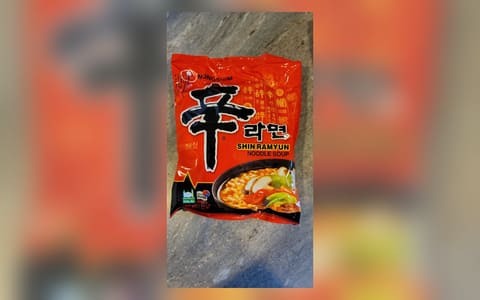
Photo: Open Food Facts contributors · CC BY-SA 3.0
How to verify
- Look on the front of the pack for the Halal logo beside 'Made in Korea'.
- Read the soup powder for beef or other meat; the Halal-marked pack lists none.
- E627 and E631 in the seasoning can be animal-derived; the Halal logo covers them.
- A pack made elsewhere, without the logo, is not shown to be Halal.
Quick checks
- Halal logo on the Korean-made pack.
- No meat in its list.
- No logo: not shown to be Halal.
What decides the answer
-
Korean-made Shin Ramyun with the Halal logo
Halal-certified -
Shin Ramyun without a Halal logo
check the list for meat; not shown to be Halal
Why this ruling
Shin Ramyun is Nongshim's spicy Korean instant noodle soup,. Whether it is Halal comes down to the pack you buy.
The Korean-made pack with a Halal logo
A Korean-made Shin Ramyun five-pack sold in the UK, Germany and Norway, made at Nongshim's Busan plant, carries a Halal logo on the front, beside "Made in Korea", and again on the back.[1] Its list has no meat. The noodles are wheat flour, potato starch, palm oil and salt; the soup powder is soya protein, yeast extract, spices, flavour enhancers, sugar and shiitake mushroom; and a third sachet holds dried vegetables. Nongshim's Mira Shin Ramyun lists no meat either.[2]
The flavour enhancers
The seasoning includes E627 and E631, which can be made by fermentation or extracted from yeast, fish or meat.[3] On the Halal-marked pack, the certificate covers them.
Packs without the logo
We found no statement from Nongshim on Shin Ramyun made in other plants. A pack without the Halal logo is not shown to be Halal, so read its list for beef or other meat, and its seasoning for the flavour enhancers. For Korean chilli paste, see gochujang.
Where you'll find it
- Spicy Korean instant noodle soup
- Cup and bag versions
- Quick noodle meals
Frequently asked questions
Is Shin Ramyun Halal?
Does Shin Ramyun contain beef?
Is Shin Ramyun vegetarian?
Scholarly view
Instant noodle seasoning can hide animal ingredients in flavour enhancers such as E627 and E631 and in meat extracts, so a recognised Halal logo is the clearest evidence. The Korean-made Shin Ramyun sold in Europe has both a meat-free list and a Halal logo. Packs without the logo should be read in full and treated as unverified.
Sources
Named Islamic, certifier, manufacturer, and regulatory sources used on this page. Inline markers like [1] jump here. Retrieval dates show when we last checked the live URL. Editorial methodology.
Manufacturer / product
-
Nongshim Shin Ramyun Noodle Soup, 5 × 120 g (made in Korea)
Open Food Facts Retrieved
Label recorded: Halal; the front and back of the pack show a Halal logo, and the front says 'Made in Korea'. Manufacturing plant: Busan, Korea. Sold in the UK, Germany and Norway. Noodles: wheat flour, potato starch, palm oil, salt, acidity regulators (E501, E500, E339), antioxidant (E306), emulsifier (E322, soya), seasoning, colour (E101). Soup powder: hydrolysed vegetable protein (soya), maltodextrin, yeast extract, salt, wheat flour, black pepper, red chilli powder, garlic, maize flour, flavour enhancers (E621, E627, E631), sugar, glucose, shiitake mushroom. Vegetable flakes: pak choi, shiitake, textured vegetable protein, carrot, red chilli, onion. May contain traces of barley, crustaceans, egg, peanuts, milk, celery, mustard, sesame and molluscs.
-
Open Food Facts Retrieved
Wheat flour, potato starch, palm oil, salt, E501, E500, E339, E306, E322, E621, E627, E631, colour E101; soup powder (seasoning, hydrolysed vegetable protein, sugar, maltodextrin, soy sauce powder, yeast extract, E621, spices, vegetable oil, garlic powder, colours), mushroom flakes, carrot, green onion, shiitake. No meat listed.
Regulatory / labelling
-
EFSA — Re-evaluation of glutamates, guanylates, inosinates and ribonucleotides (E620–E635)
EFSA Retrieved
Guanylates and inosinates (E627, E631) are produced by fermentation or by extraction from yeast, fish or meat.
People also check
Related ingredients and products for this item.
Browse this topic
Open the parent category hub for more foods in the same group.