
How to verify
- Ask pork, chicken, beef, prawn, or vegetable.
- Refuse pork.
- For meat fillings, require Halal slaughter.
- Ask about lard in the dough or pan.
- Ask whether the dip includes Shaoxing wine.
- Shared steamers and fryers with pork dumplings are a reason to skip.
Quick checks
- Ask the filling: pork, or pork and cabbage, is the most common in jiaozi and gyoza.
- For chicken, beef or lamb, ask for Halal slaughter.
- Ask whether the dip or filling contains Shaoxing wine, and whether steamers and fryers are shared with pork.
What decides the answer
-
Halal-slaughtered chicken or beef, pork-free steamer
Halal -
Vegetable dumpling, plant dough, no wine dip
Halal -
Unverified restaurant plate
Halal if verified -
Pork filling or lard dough
Haram
Why this ruling
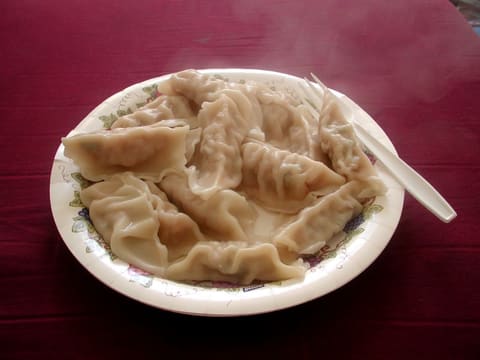
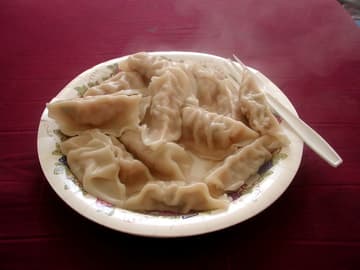
Dumpling is a shape, not a recipe: a wrapper of dough folded around a filling, then boiled, steamed or fried. Nearly every cuisine has one, and the filling, the wrapper and the dip change the answer from one to the next.[1]
Dumplings by name
| Dumpling | Where | Usual filling | Halal? |
|---|---|---|---|
| Jiaozi, potstickers | China | Pork and cabbage; also chicken, beef, prawn, vegetable | Pork, no; others only if Halal |
| Xiaolongbao (soup dumplings) | Shanghai | Pork, with a pork jelly that melts into soup | No |
| Shumai, wonton | China | Pork and prawn | Usually no |
| Har gow | Cantonese dim sum | Prawn; wrapper sometimes made with lard | Ask about the wrapper |
| Gyoza | Japan | Pork and cabbage | Usually no |
| Mandu | Korea | Pork, beef, tofu or kimchi | Ask |
| Momo | Nepal, Tibet | Chicken, buffalo, vegetable | Only if the meat is Halal |
| Manti | Turkey, Central Asia | Lamb or beef | Only from Halal slaughter |
| Pelmeni, pierogi | Russia, Poland | Pork and beef; potato and cheese | See pierogi |
Three things to check
- The filling. Pork is the default in much of East Asia.[2] Other meat needs Halal slaughter.
- The dough and the pan. Some wrappers, and some pan-frying, use lard.
- The wine. Chinese fillings are often marinated with Shaoxing rice wine, and some dipping sauces include it.[3] Plain soy sauce and black vinegar dips are fine; see soy sauce.
Halal dumplings
Chinese Muslim (Hui and Uyghur) restaurants, often marked qingzhen, make lamb and beef dumplings, and Halal dim sum restaurants exist in Malaysia, Indonesia, Singapore and many Western cities. Frozen dumplings list their filling; look for a Halal mark. Vegetable dumplings are the easiest order elsewhere, if the wrapper and dip are clear.
For more of the region's food, see the East Asia guide.
Where you'll find it
- Chinese jiaozi and Japanese gyoza
- Vegetable or prawn dumplings
- Halal beef or chicken dumplings
Frequently asked questions
Are dumplings Halal?
Is the wrapper Halal?
What about the dipping sauce?
Where can I find Halal dumplings?
Scholarly view
Pork fillings are Haram. Other meats need Islamic slaughter. Cooking wine in dips is prohibited. ‘Dumpling’ is a shape, not a certificate.
Sources
Named Islamic, certifier, manufacturer, and regulatory sources used on this page. Inline markers like [1] jump here. Retrieval dates show when we last checked the live URL. Editorial methodology.
Islamic / scriptural
-
Qur'an Retrieved
Swine prohibition for pork dumplings and lard; slaughter rule for other meats.
-
Context / background
-
Jiaozi — East Asian filled dumplings
Wikipedia Retrieved
Culinary identity: Chinese wheat dumplings typically filled with ground meat and vegetables; pork is a common filling; pan-fried and boiled styles. Identity context, not a Halal certificate.

Halal-conscious recipes
A substitution-led recipe that uses this analysis.
Browse this topic
Open the parent category hub for more foods in the same group.